
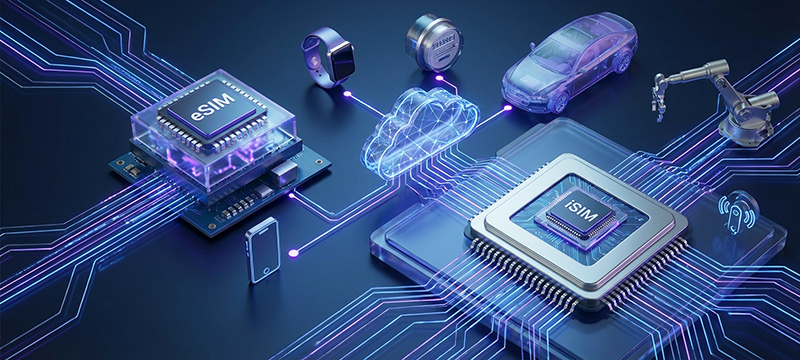
By 2026, eSIM in IoT is no longer “new”—it’s the default expectation in many RFPs. iSIM is also moving beyond demos, pushed by module and chipset roadmaps that aim to reduce footprint, simplify hardware, and tighten security. Yet once projects leave PowerPoint and enter factories, fleets, and multi-operator reality, the story gets messier. Even teams that already understand Remote SIM Provisioning (RSP) often discover that the hardest part is not the SIM form factor—it’s the operational system you must build around it.
This article focuses on what repeatedly derails real deployments: ecosystem fragmentation, manufacturing constraints, backend integration debt, commercial/contract friction, and the “long tail” of lifecycle operations that start after the first shipment—not before.
1. Standards are improving, but the transition period is painful
In 2026, many deployments still sit across different generations of eSIM architecture. Some fleets remain on the older M2M approach, others rely on consumer-style flows, while new programs try to standardize on the IoT-specific model designed to reduce complexity at scale. The issue isn’t that any single standard is unusable; it’s that mixed fleets force you to operate multiple processes, suppliers, and testing matrices at once. That complexity becomes visible when you try to unify tooling, reporting, and incident response across regions and device families.
The promise of the IoT-focused approach is real—simpler roles, clearer orchestration, and a model designed for headless devices. But during the transition, vendors rarely advertise the cost of running “two worlds” in parallel: duplicated integrations, duplicated certification paths, and duplicated runbooks.
2. “One SKU globally” still breaks on operator and roaming reality
Marketing loves the phrase “single global SKU.” In practice, operator policies, roaming constraints, and local market realities still force exceptions. The technical ability to change profiles remotely doesn’t automatically resolve commercial constraints, compliance rules, or regional limitations on how connectivity can be sourced and managed. That’s why some deployments end up with regional profile strategies anyway—just implemented digitally rather than physically.
Even when profile swaps work flawlessly, the operational question remains: who owns the relationship with which operator in which country, under what SLA, and with what escalation paths? eSIM reduces truck rolls and SIM swaps; it does not eliminate connectivity governance.
3. Bootstrap connectivity is a hidden architecture decision
RSP needs a working data path to reach the provisioning backend. So every project must answer an unglamorous question: how does a device connect before it has the “right” operational profile? Some teams use an initial bootstrap profile, some rely on factory-loaded connectivity, and others attempt alternative onboarding methods.
This choice impacts everything: bill of materials, security posture, activation flows, device UX (or lack of UX), and even customer support scripts. It also determines how painful it will be when provisioning fails in the field. If your bootstrap profile is fragile—or commercially constrained—you can end up with devices that are “alive” but not serviceable.
4. Manufacturing and provisioning don’t naturally align
Factories optimize for throughput, predictability, and minimal variance. Provisioning flows introduce variance: network dependencies, backend dependencies, and security dependencies. That friction is exactly why in-factory provisioning has become so prominent: it tries to shift complexity earlier, when devices are still in controlled conditions, and reduce chaos later in the field.
But the factory is not a lab. If your provisioning step adds minutes, creates intermittent failures, or requires specialized handling, the economics change quickly. Teams often underestimate how much work it takes to make provisioning “factory-safe”: stable connectivity, repeatable test hooks, clear failure states, and reliable rework processes that don’t create security exceptions.
5. Backend integration is where timelines go to die
The eSIM/iSIM conversation usually starts with hardware. The schedule risk usually sits in software integration: orchestrating profile lifecycle, tying provisioning events to device identity, integrating with your CMDB/asset system, and ensuring your support teams can understand what happened when something fails.
Most enterprises already have device management systems. Most connectivity providers already have portals. Neither is automatically designed for the operational detail you’ll need at scale: accurate inventory of profile state, auditability of changes, cross-carrier visibility, and deterministic workflows for suspension, reactivation, replacement, and transfer of ownership.
If you’re migrating from earlier approaches, you may also face a data reconciliation problem: mapping historical ICCID/IMSI identity models to new lifecycle reporting so that finance, security, and operations still trust the numbers.
6. iSIM changes the trust chain—and the debug story
iSIM can tighten security and reduce physical attack surfaces, but it also shifts dependencies. With a discrete SIM or eSIM, suppliers and responsibility boundaries can be clearer. With iSIM, the SIM capability is embedded into the device’s primary silicon stack, which alters how you think about certification, vulnerability management, and lifecycle support.
One under-discussed friction point: engineering and manufacturing teams still need diagnostic access. Secure-by-default designs can collide with debug needs, RMA triage, and field failure analysis. If the “secure element inside” becomes a black box too early, you can end up with longer failure investigations and higher replacement rates—especially during ramp.
7. Certification and interoperability remain non-trivial
Even when the architecture is standardized, deployments can be slowed by interoperability testing across modules, SIM OS, remote management platforms, and operator networks. The ecosystem is improving, but “compliant” does not always mean “interchangeable in your exact scenario.” Edge cases show up in low-power regimes, intermittent coverage, constrained radio conditions, and devices that spend most of their life asleep.
This is why “it worked in a demo” can be dangerously misleading. A demo proves a path exists. A deployment proves you can repeat it reliably across thousands (or millions) of devices with predictable failure rates and predictable recovery paths.
8. Lifecycle operations are the real ROI battleground
eSIM and iSIM value is often framed as avoiding physical SIM swaps. In reality, ROI is won (or lost) in long-term operations: minimizing connectivity downtime, avoiding stranded devices, simplifying ownership transfer, supporting refurb/redeploy, and handling operator sunsets without panic.
Teams that succeed in 2026 treat eSIM/iSIM as an operational capability, not a component choice. They invest in automation, observability, clear escalation, and a governance model that aligns procurement, security, and operations—because the “SIM problem” is rarely just a SIM problem.
What to ask vendors in 2026 (before you commit)
Instead of focusing only on form factor, ask vendors to walk through real failure modes and operational workflows:
Bootstrap and recovery: What happens if the device can’t reach the provisioning backend on first boot—or after a profile swap?
Factory robustness: What is the expected failure rate during in-factory provisioning, and what is the rework process?
Fleet observability: Can you export full lifecycle logs and correlate them with device identity in your own systems?
Interoperability scope: Which module/SIM OS/remote management/operator combinations are proven in production, not just validated in a lab?
iSIM responsibilities: Who patches what, who certifies what, and who supports failure analysis when the SIM is inside the silicon stack?
Commercial governance: How do contracts, SLAs, and escalation work when multiple operators and resellers are involved?
Bottom line
By 2026, eSIM and iSIM are strong building blocks—but the deployment challenges vendors don’t advertise are mostly about systems: factory integration, backend orchestration, operator readiness, and lifecycle operations. Teams that budget time for integration debt, design for failure recovery, and build operational observability early are the ones that actually realize the “global, flexible connectivity” promise—at scale.
The post eSIM + iSIM in 2026: Real Deployment Challenges That Vendors Don’t Advertise appeared first on IoT Business News.
