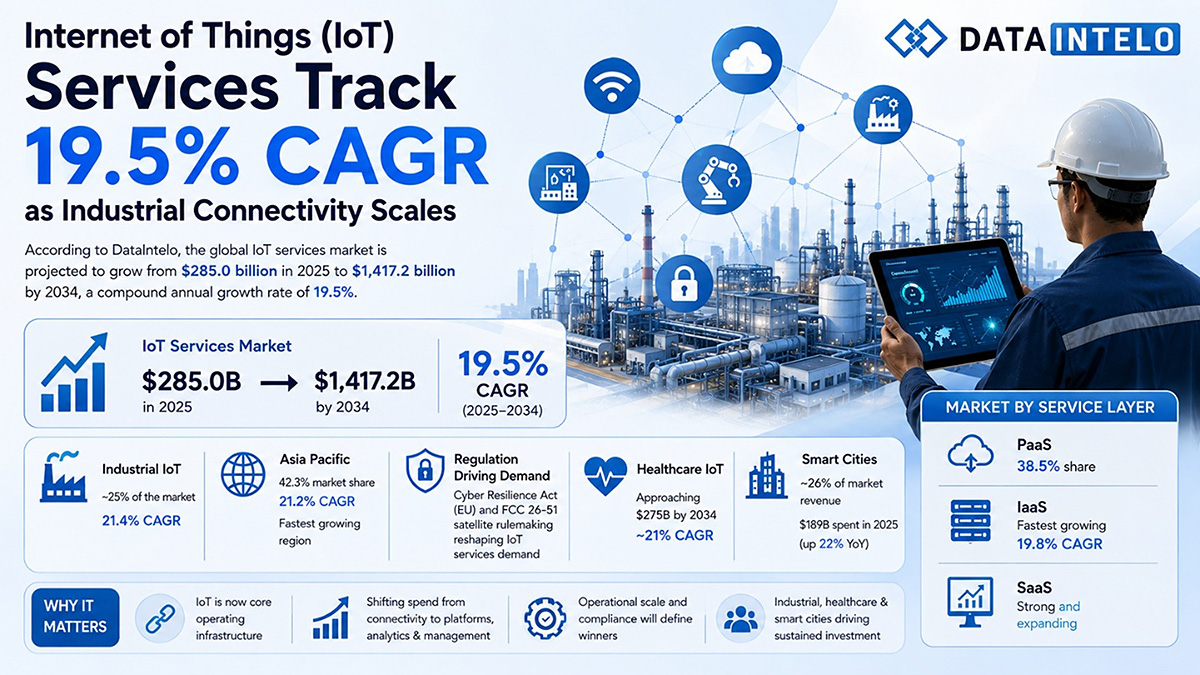

According to DataIntelo, the global IoT services market is projected to grow from $285.0 billion in 2025 to $1,417.2 billion by 2034, a compound annual growth rate of 19.5%. The pace suggests that companies are no longer testing IoT within their operations; in many cases, they have already built it into how they run.
For most of the past decade, IoT services were treated as an emerging opportunity, something businesses were still “exploring.” That framing increasingly looks outdated. Across the PaaS, IaaS, and SaaS layers that make up the IoT services market, a $285 billion base has already been established, and DataIntelo expects it to grow nearly fivefold over the next nine years.
That scale points less to a wave of fresh innovation than to a deepening reliance on the technology: connectivity services, device management platforms, and analytics tools have become infrastructure that manufacturers, energy companies, healthcare organizations, and municipalities now depend on to run daily operations. What is worth watching closely is not simply how fast the market is growing, but why, and what could get in the way.
From connectivity pilots to operating infrastructure
The shift is visible in the services mix. IaaS — the layer covering managed cellular connectivity, device fleets, and gateway infrastructure — is forecast to grow slightly faster than PaaS (19.8% versus 18.8% CAGR), even though PaaS still holds the largest revenue share, at roughly 38.5%. Enterprises are not simply building more IoT applications; increasingly, they are paying to have large, distributed device estates operated on their behalf, with provisioning, firmware updates, security policy enforcement, and lifecycle management delivered as a managed service rather than built in-house.
Broader connectivity data points in the same direction. Berg Insight’s most recent figures put global cellular IoT connections at 4.2 billion at the end of 2025, up 11% year-on-year, while connectivity revenue grew only 5% and monthly ARPU fell 7% to €0.31. In other words, the device base is expanding faster than revenue per device. As connectivity margins compress, spending appears to be migrating toward the layers that make massive device estates operable — platforms, analytics, and lifecycle management — which lines up with where IoT services growth is currently concentrated.
Industrial IoT is a structural growth engine
Industrial IoT (IIoT) accounts for close to a quarter of the IoT services market and is expected to grow at a CAGR of around 21.4%, ahead of the broader market average. That trend is echoed in neighboring hardware data: Berg Insight projects that wireless device shipments for industrial automation will reach 8.5 million units by 2030, as manufacturers move from wired fieldbus systems toward wireless sensors and controls. Wireless industrial networks don’t necessarily reduce the need for services; if anything, they can increase it, since they require ongoing management, security monitoring, and integration that hardwired connections didn’t.
Manufacturing is expected to generate more than $450 billion in IoT service revenue by 2034, driven largely by predictive maintenance and smart-factory initiatives. Research from McKinsey has found that predictive maintenance programs can cut unplanned equipment downtime by up to 50% and lower maintenance costs by 10–40% compared with reactive approaches. Separately, McKinsey’s analysis of AI-enabled supply-chain management found that early adopters improved inventory levels by around 35% relative to slower-moving peers. Results like these vary by industry and implementation, but they help explain why predictive maintenance and connected supply chain tools continue to attract sustained investment rather than being treated as one-off transformation projects.
Scaling remains harder than piloting, though. Recent industry commentary has focused on this gap, arguing that the main barrier to enterprise-wide rollout is less about sensor or connectivity technology and more about operational readiness: change management, workforce processes, and integration with existing plant systems. That suggests the 19.5% CAGR may not be evenly distributed — organizations with the operating discipline to scale could capture a disproportionate share of the value, while those still running fragmented pilots may fall further behind.
Regional concentration is widening, not narrowing
Asia Pacific holds 42.3% of the global IoT services market and is also forecast to grow fastest among major regions, at a 21.2% CAGR, meaning its lead looks set to widen through 2034. That pattern mirrors raw connectivity data: China’s three major operators — China Mobile, China Telecom, and China Unicom — together account for a substantial share of global cellular IoT connections, with China Mobile alone reporting 1.48 billion connections at the end of 2025. For providers elsewhere, Asia Pacific is increasingly less a growth opportunity to expand into and more a market whose scale is starting to set the benchmark for global averages.
North America (28.5% share) and Europe (18.7%) are more mature markets, shaped by cloud incumbency and by regulation-led industrial and smart-city initiatives. Europe is the slowest-growing of the larger regions, at a 17.3% CAGR, with regulation and compliance requirements likely to play a particularly important role in shaping demand.
Regulation is shaping demand, not just constraining it
Two developments illustrate how policy is beginning to shape IoT service demand rather than simply restrict it. The EU’s Cyber Resilience Act now requires vulnerability reporting and security-by-design features in connected devices, moving those capabilities from optional extras to standard procurement criteria for connected products.
In the US, the FCC voted on August 6, 2026 to open a rulemaking proceeding (NPRM FCC 26-51) exploring whether devices operating under its Part 15 unlicensed rules — the same category that covers Wi-Fi, Bluetooth, and most consumer and industrial IoT sensors — should be allowed to communicate directly with satellites.
The proceeding initially focuses on more than 200 MHz of spectrum in the 2.4 GHz and 5.8 GHz bands and is meant to complement, rather than replace, the FCC’s existing licensed framework for direct-to-device satellite connectivity. If adopted, the rule could let manufacturers add satellite reach to devices that already use unlicensed radios, without requiring devices to incorporate a separate licensed cellular or satellite radio interface — a change that could affect the cost basis for device makers that currently rely on licensed spectrum for coverage outside terrestrial network range. The rulemaking is still in its comment phase, and the technical and interference rules that would govern any eventual service remain unresolved.
Mandatory security compliance is likely to raise the cost of entry, which could slow adoption among cost-conscious buyers. At the same time, it may also shift investment toward providers that already have compliance automation and device-identification tooling in place — potentially favoring larger platform players with the resources to automate compliance over smaller companies offering point solutions.
Verticals to watch
Healthcare-related IoT services, including remote patient monitoring and hospital asset tracking, are projected to approach $275 billion in annual revenue by 2034, growing by nearly 21% a year. Part of that momentum reflects growing regulatory attention to AI-enabled medical devices. On August 18, 2026, the FDA’s Digital Health Center of Excellence published a discussion paper on how it might regulate generative-AI-enabled medical devices, proposing a competency-based assessment model and opening a public comment period through October 19, 2026. The paper is exploratory rather than binding — it does not set new requirements — but it signals the kind of design and certification questions that connected medical device makers with generative-AI features may need to prepare for as the framework develops.
The smart cities segment, which accounts for nearly 26% of IoT services market revenue, is moving from standalone pilot projects toward integrated deployments spanning multiple municipal domains, such as traffic management, utilities, and public safety. Global smart-city technology spending reached an estimated $189 billion in 2025, according to IDC, up 22% from the year before. Given the number and scale of active municipal deployments worldwide, the segment increasingly resembles a utilities or telecom-style spending category rather than a discretionary IT line item.
Implications for decision makers
For buyers, a market growing at a 19.5% CAGR suggests that IoT is becoming less of a build-versus-buy decision within IT and more of a distinct procurement category, with its own dynamics, obligations, and total-cost-of-ownership considerations that extend beyond the connectivity agreement itself.
Compressed cellular ARPU currently favors buyers negotiating on raw connectivity pricing, but that leverage may shift toward providers as managed services and compliance tooling become harder to separate from connectivity itself. For providers, the fastest-growing segments — industrial automation, managed connectivity, and compliance-ready healthcare platforms — tend not to be the ones with the most connected devices, but the ones where the service layer solves a problem that raw connectivity alone cannot.
The post Why IoT Services Are Becoming Critical Infrastructure for Enterprise Deployments appeared first on IoT Business News.