
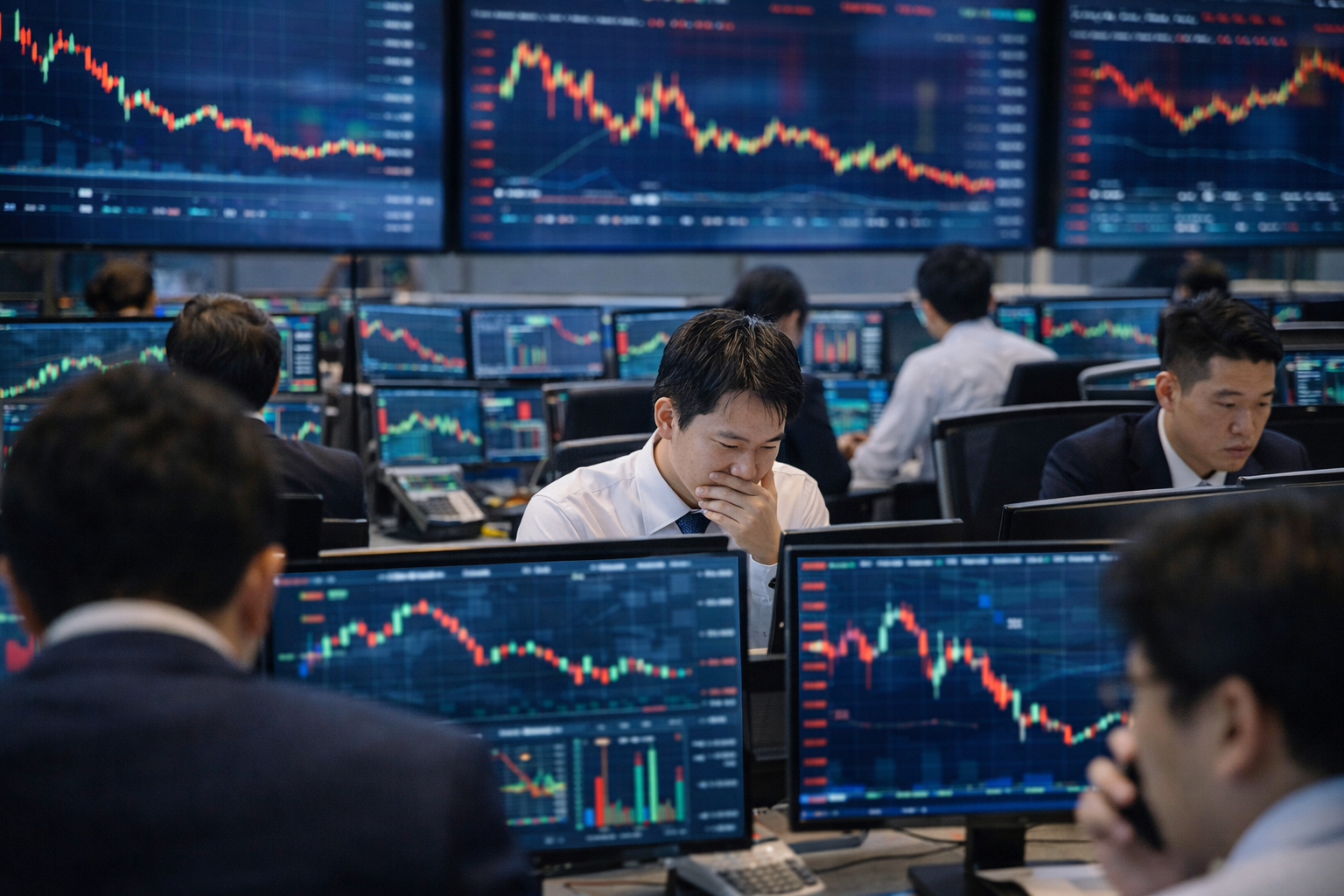
The KOSPI finished higher on Tuesday but surrendered most of an early AI-driven surge, while the Nikkei 225 remained shut for Japan’s Silver Week holidays, leaving Tokyo investors facing a potentially volatile reopening on Thursday.
South Korea’s benchmark ended about 0.5% higher after jumping more than 2% shortly after the open. Samsung Electronics finished up roughly 0.7%, while SK Hynix reversed an earlier gain and fell about 1.5%.
The fading rally contrasted with the morning session, when both chipmakers jumped more than 2% after the Nasdaq Composite closed at a record.
KOSPI rally loses momentum after a powerful start
The KOSPI initially climbed above 7,170 as investors chased semiconductor shares following Monday’s 4.3% surge in the Philadelphia Semiconductor Index.
Meta’s new Muse AI assistant has revived enthusiasm around AI infrastructure spending, while AMD, Intel and Arm posted sharp gains on Wall Street. Lower oil and US Treasury yields added to the early risk-on mood.
But the Korean rally lost momentum as investors took profits into the strength.
Kiwoom Securities analyst Han Ji-young told MoneyToday that the combination of weaker oil, lower US yields and renewed confidence in Meta’s AI ecosystem had created a favourable environment for Korean semiconductor shares.
She also noted that the decline in WTI from above $100 had reduced one of the biggest macro pressures on equities.
The late reversal in SK Hynix shows that enthusiasm was not broad enough to sustain the opening move, even as the KOSPI remained positive for a third straight session.
Nikkei 225 builds up three days of catch-up risk
Japan’s cash market remains closed through Wednesday, leaving the Nikkei 225 frozen at Friday’s close of 65,018.95. Tokyo reopens on Thursday after three consecutive holidays.
That means the Nikkei has yet to absorb Monday’s record Nasdaq close, Tuesday’s Asian chip rally, falling oil prices or developments ahead of Thursday’s Trump-Xi meeting.
The yen is adding another complication. It weakened to around 157.5 per dollar on Tuesday despite the Bank of Japan raising rates to 1.25% last week.
Markets were disappointed by two dissenting votes and the absence of a stronger signal that another increase is imminent.
Capital Economics senior markets economist James Reilly told the Japan Times that the BOJ had again failed to generate sustained yen strength, leaving the currency increasingly dependent on developments in US rates.
Oil and yields keep the broader Asia backdrop supportive
Elsewhere, Taiwan’s Taiex finished about 0.2% higher after hitting a record during the session, while Hong Kong’s Hang Seng gained roughly 0.6% and mainland Chinese stocks advanced around 0.4%.
Brent crude held near $101 a barrel after falling sharply from last week’s near-$110 peak, while the US 10-year Treasury yield eased towards 4.95%.
Both moves reduce pressure on energy-importing Asian economies and expensive technology shares.
Citi Research said that positioning remains unusually bearish across the Nikkei and KOSPI, creating scope for sharp short-covering rallies if positive catalysts persist.
The post Asia tech rallied again but Korea’s fade may be the signal Japan should watch appeared first on Invezz
