While you may best remember handheld insecticide sprayers from their pop culture appearances in Mickey’s Garden (1935) or The Godfather (1972), these “FLIT guns” once represented a huge leap forward in our struggle against destructive pests.
The device was an innovation to dispense FLIT, the brand name of a mineral-oil-based insecticide manufactured by the Standard Oil Company beginning in 1923. A pneumatic hand pump affixed to a reservoir allowed home gardeners to easily and accurately distribute a cloud of fine insecticidal mist around garden beds, water barrels, and picnic tables. FLIT guns helped others limit pests throughout their homes too.
Inventions in personal protection from mosquitoes were not new. Herodotus tells us ancient Egyptians raised their dwellings to increase air flow and avoid gnats and other pests. For centuries people had worn protective headgear and long-sleeved clothing to prevent mosquito bites; and they had slept under nets and installed screens, like these in the Sears catalog from 1926.
By the early 1900s, inventors had combined a growing knowledge base — developed by entomologists like Leland Howard who experimented with mixing different amounts of kerosene, oil, and other chemicals — with improved application tools, including aircraft. The centuries-old fight against mosquito-borne diseases accelerated as private sector firms, individual home- and property-owners, and civil society rushed toward broad-scale treatment of land and water. The market for better solutions continues to produce iterative improvement measured in lives saved.
Taxpayer funded efforts to control pests and mosquito populations included successful campaigns in and around the Panama Canal, along with municipal aerial spray campaigns (after 1925). Spraying around military bases was introduced to prevent domestic reintroduction of malaria by infected returning soldiers, and continues today to protect families nearby. Widespread application efforts treated millions of homes and drained swamps in 13 southern states. The National Malaria Eradication Program directed county health workers to spray for mosquitoes wherever cases of malaria were reported. By 1951, the disease was effectively gone from the United States.
Broad public health campaigns could not address every household’s particular needs. Mosquitos and other pests remained a problem. Standard Oil of New Jersey, with its convenient handheld sprayer, met the needs of some households. But more diverse priorities and demands from individual consumers created opportunities for private innovation.
People wanted to apply insecticide in places where they lived and slept, as well as on their land. They wanted control over where and how much was sprayed, and whether it would stain their clothes or harm their animals. They wanted to treat for many kinds of pests at once, quickly. As private sector innovation sought consumer dollars, options proliferated.
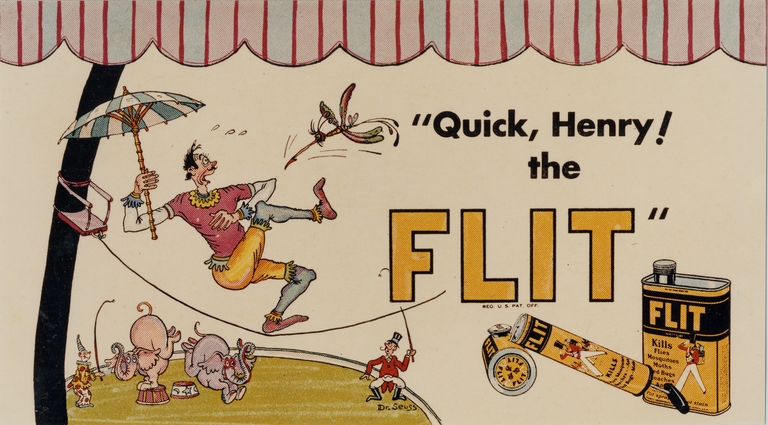
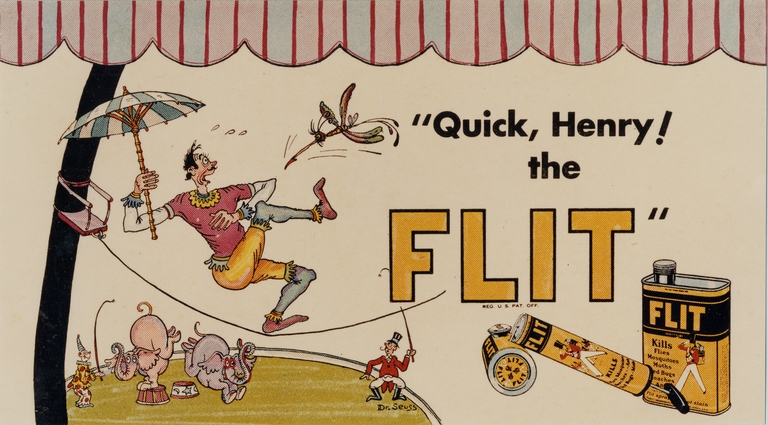
FLIT rose to the occasion. A then-unknown Theodor Geisel — beloved children’s author Doctor Seuss — drew advertisements for the Saturday Evening Post (1927), Good Housekeeping (1926 and 1927), and Woman’s Home Companion (1929). Each pointed out a use-case (sometimes absurd) for the pest control product.
Special Collections & Archives, UC San Diego
Special Collections & Archives, UC San Diego
The Sears catalog for Fall 1936 boasts a “Go-Nex Fly and Mosquito Spray” for use inside the home, and a seemingly generic household sprayer. Sears shoppers could easily acquire (with some shipping delay) mosquito spray — and a handy way to apply it where they most needed it — for approximately $0.58 (a little over $14 in today’s dollars).
A robustly competitive private sector encourages rapid innovation, particularly for goods that combine insights from the natural sciences and mechanical invention and caters to individual values. In this and many other instances, the profit motive and competitive market forces play an important role in making people’s lives better.
Herodotus could scarcely have imagined the power Mickey — and anyone else with $14 — would one day wield.