
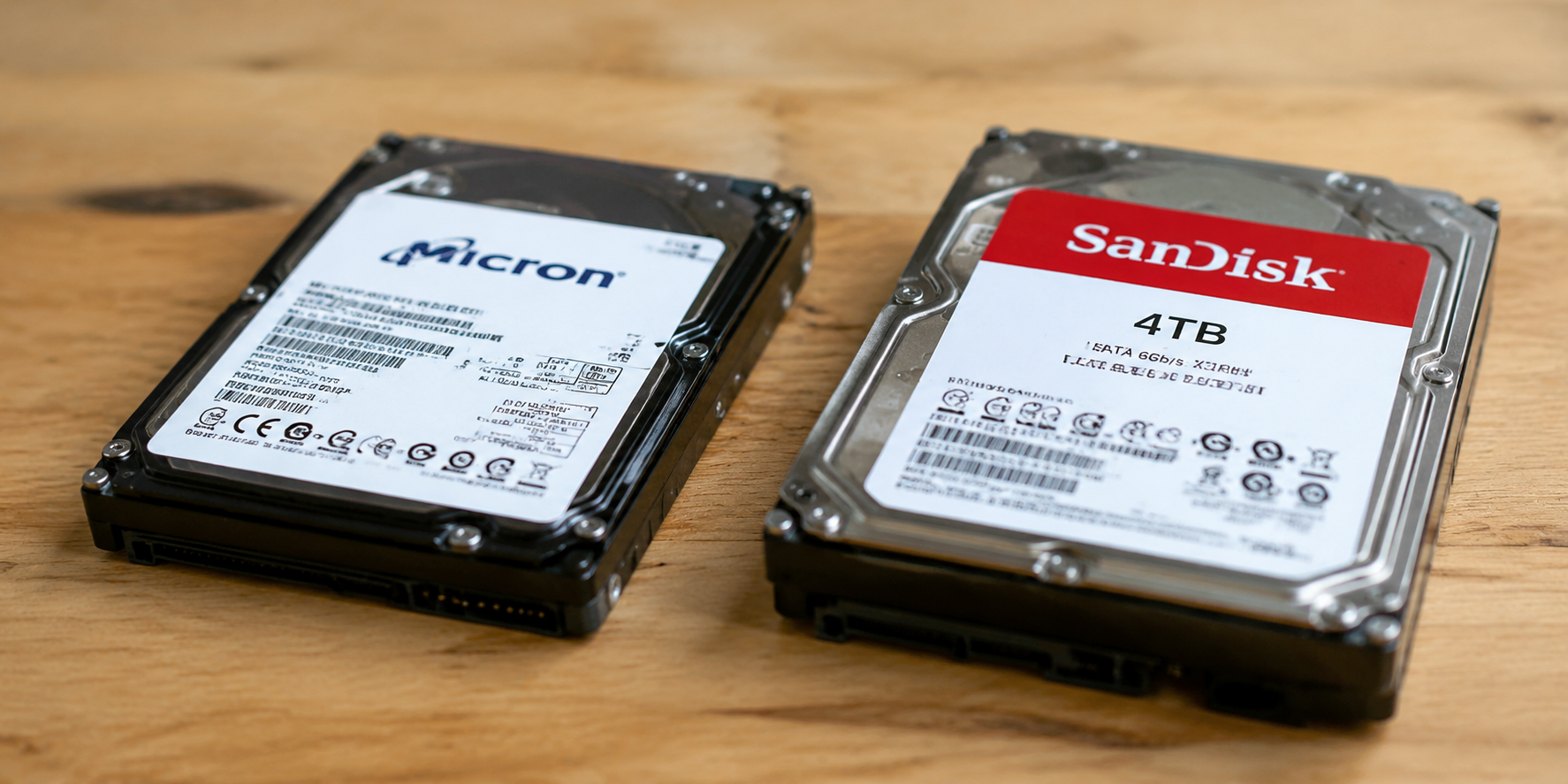
Micron and SanDisk stocks rose in Tuesday premarket trading, extending the memory-stock rally as investors bet on tight supply and AI demand.
The gains follow Friday’s surge, when Micron jumped 6.1% and SanDisk climbed 11.9%.
But the rally is creating a new risk.
Memory prices have risen so sharply that smartphone and PC makers are raising prices, cutting specifications and rethinking production.
TrendForce data suggests some consumers are buying devices earlier to avoid further increases.
AI is keeping the shortage alive
The immediate fundamentals remain strong, as AI data centres are consuming huge amounts of DRAM and NAND, while manufacturers are directing capacity towards higher-value products such as high-bandwidth memory.
That benefits Micron through its exposure to HBM and conventional DRAM, while SanDisk remains a major beneficiary of tight NAND supply.
New capacity cannot arrive quickly.
TechInsights chief strategy officer Dan Kim told the Financial Times that no meaningful new supply is expected until at least 2028, as AI demand continues to overwhelm available capacity.
Micron’s expansion illustrates the challenge. Its planned New York complex is not expected to deliver meaningful output until 2030, while its Idaho facility is expected to begin wafer production in 2027.
Investors therefore have reason to believe the shortage can continue for the foreseeable future.
Customers are starting to feel the price
The more important risk is appearing downstream.
TrendForce said Tuesday that global smartphone production reached about 275 million units in the second quarter, down 8% from a year earlier.
The research firm raised its 2026 production forecast to 1.07 billion units, but warned that the improvement did not represent a genuine recovery.
Some consumers brought purchases forward because they feared further memory-driven device price increases, while manufacturers restored production previously cut too aggressively.
TrendForce warned that smartphone output could face renewed pressure in 2027 as those effects fade and memory contract prices continue rising.
Bernstein sees the same tension. According to Investing.com, the firm said it still believes “demand destruction in the consumer segment will eventually happen,” even as server demand absorbs additional supply.
Bernstein expects memory-price increases to slow before prices gradually peak and begin normalising from the second half of 2027 into 2028.
AI can still keep the boom alive
Demand destruction in smartphones and PCs does not automatically end the memory upcycle.
For investors tracking Micron, SanDisk and other semiconductor names through the best trading apps, the key distinction is between consumer and AI-driven demand.
AI customers are less price-sensitive because memory is essential to deploying valuable computing infrastructure. Consumer buyers can delay purchases, choose cheaper devices or accept lower specifications.
That difference is already reshaping the market.
IDC senior director Nabila Popal told The Verge that memory prices could eventually stabilise at a “new normal” that remains at least three times historical levels.
The Verge also reported that smartphone and PC makers are shifting towards premium devices, raising prices or reducing memory configurations to protect margins.
For Micron and SanDisk, the key question is becoming the mix of demand rather than demand alone.
As long as AI infrastructure spending remains strong, weaker consumer volumes may be manageable.
But if smartphone and PC demand deteriorates faster than data-centre demand expands, elevated pricing could eventually work against suppliers.
The post Micron and SanDisk up nearly 2% premarket, but one risk is getting harder to ignore appeared first on Invezz
