
In 2084 — the year my kids turn 63 and 65 — the United Nations forecasts that the world’s population will peak at 10.3 billion and then begin falling.
Even before then, this process will be well along in some parts of the world.
The population of Europe will have fallen by 17 percent from its present level and China’s by 42 percent. In the span of my children’s lives, the equivalent of one in every six Europeans will have disappeared — and four out of every ten Chinese.
The population of the United States, by contrast, will be 18 percent larger than it is now, but that rate of growth is less than one-third of the 72 percent increase in the previous 59 years.
This is the result of collapsing birthrates. Worldwide, the total fertility rate has fallen from 5.3 in 1963 to 2.2 now. In the United States, it has fallen from 3.8 in 1958 to 1.6 and in Europe from 2.7 in 1951 to 1.4. China’s decline is much steeper, down from a higher peak, but also to a lower level, from 7.5 in 1963 to 1.0.
While fewer people have been born, those who have are living longer. Since 1950, life expectancy at birth worldwide has risen from 46 to 74. In the United States, it has risen from 60 to 76 and in Europe from 62 to 80. Again, China’s performance stands out thanks to a low starting point, rising from 44 to 79.
Together, these trends mean that not only will the planet get emptier after 2084, but it will get a lot older before that.
The median age of the population of Planet Earth has risen from 20 in 1973 to 31 now and is forecast to rise to 40 in 2084. In the United States, the median age has risen from 18 in 1962 to 45, where it will remain until 2084, and in Europe it has risen from 28 in 1955 to 43, and it will rise to 47. China’s increase has been similar, from 18 in 1972 to 41, but it is forecast to keep on rising, reaching 62.
In the United States, the total dependency ratio — the number of those aged under 25 or over 65 as a share of the working-age population — will increase by 18 percentage points between now and 2084, with all of that coming from a 19-percentage-point increase in those aged over 65. In Europe, the ratio will increase by 25 percentage points with those aged over 65 accounting for 95 percent of that, while in China the ratio will increase by 85 percentage points with all of that coming from an 86-percentage-point increase in those aged over 65.
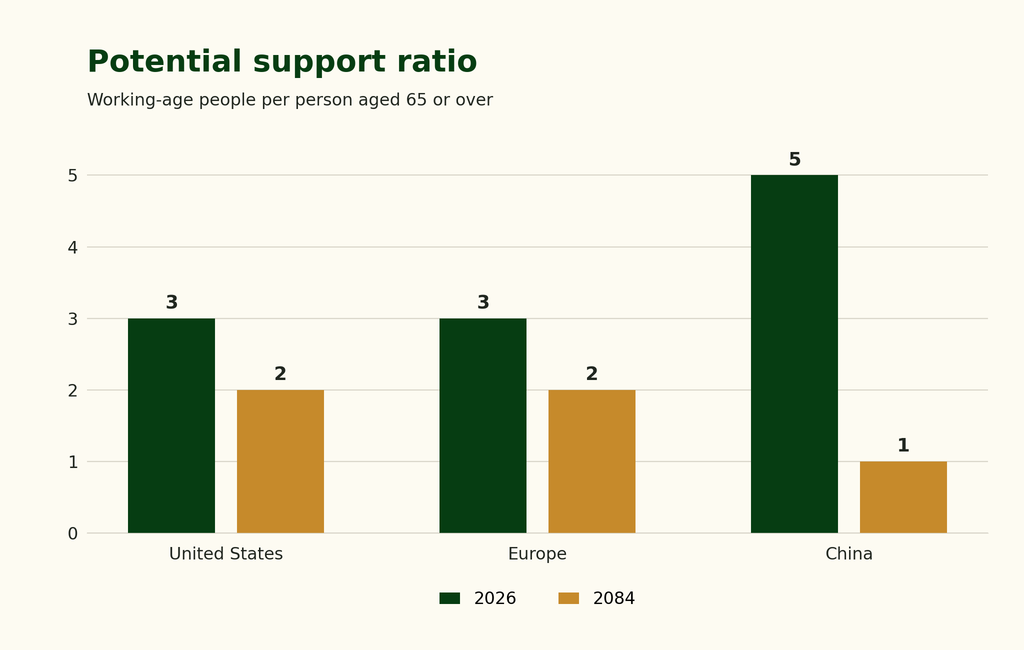
By 2084, the potential support ratio — the number of working-age people to each person aged 65 or over — will fall from three to two in the United States and Europe and from five to one in China.
United Nations World Population Prospects
Demographics and Economics
What will the economic consequences be of a population growing more slowly and eventually shrinking and getting older at the same time?
Since gross domestic product (GDP) is just the sum of each worker’s individual product, it follows that slower growth in the number of workers — or outright shrinkage — means slower growth — or outright shrinkage — of GDP, ceteris paribus.
∆ GDP = ∆ Employment + ∆ GDP per worker
But ceteris is rarely paribus. If the growth rate of output per worker increases to offset the declining growth rate of workers, then GDP might continue to grow at the same or even an accelerated rate.
While total GDP might matter for geopolitical heft, it is per capita GDP which matters for living standards. An aging population tends to be one where employment grows more slowly than total population, and as the growth rates of employment and total population increasingly diverge, the growth of output per worker will have to increase at a greater rate if per capita GDP is to continue growing at the same rate.
∆ GDP per capita = (∆ Employment + ∆ GDP per worker) – ∆ Population
The key question, then, is what happens to per-worker productivity.
Optimists and Pessimists
A new paper from economists Daron Acemoglu, David Autor, Keelan Beirne, and Andrew Scott, “Baby Busts and Growth Booms: Demographic Change and the Macroeconomy,” offers an encouraging forecast.
The authors analyze “seven decades of demographic change to assess the impact of aging and declining populations on economic performance across countries and within the United States.” Their findings “challenge the prevailing pessimism: lower birth rates, and the aging and shrinking populations they have produced, have raised rather than lowered GDP per “worker”…during these decades,” they write. “The gain in GDP per worker has been large enough to fully offset the negative effect of population decline, leaving aggregate GDP broadly unaffected.”
The authors suggest that this is because of “the endogenous response of technology to labor scarcity.” In other words, as labor becomes relatively scarce, it also becomes relatively more expensive and producers have an incentive to substitute capital for labor, making each unit of labor more productive. As regards aging, the authors argue that it is the scarcity of younger workers specifically that induces the positive productivity response.
By contrast, economists Jesus Fernandez-Villaverde and Patrick Norrick paint a pessimistic picture in their new paper, “Terra Incognita: The Economics of a Shrinking World.”
They note that a smaller population will generate fewer ideas; that “an aging population starts fewer firms, and reallocation slows down.” Older workforces and firms adopt new technologies more slowly, all of which slows the growth of per-worker productivity. In addition, they note that “our capacity to service the public debt and to meet Social Security obligations depends on total output,” not per capita. As the potential support ratio declines, the fiscal burden on those working (to support those not working) will increase.
It is difficult to answer these questions empirically because there is no precedent for what the world is forecast to experience over the next few decades. “[T]his has never happened before in our history as a species, not even during wars or pandemics,” Fernandez-Villaverde and Norrick write, and Acemoglu, Autor, Beirne, and Scott concede: “Our findings describe the past; whether they provide a reliable guide to the economic consequences of coming demographic transitions is not yet established… Changes this rapid are outside the support of the historical evidence, and could theoretically yield different adjustment dynamics from those we document.” To put it bluntly, we are flying blind.
Whoever is right, if these forecasts are even broadly correct, we can scarcely imagine the world our grandchildren will live in.
