
“A calamity ordained by Heaven may be escaped; A calamity ordained by oneself is inescapable.” So warns Shujing, the ancient Chinese Book of Documents. If only Mao Zedong had heeded this call to humility.
Despite a long history of civil strife, conflict brought by foreign powers, and countless natural disasters, the worst of China’s sufferings were self-inflicted wounds. Mao’s regime took power in October of 1949, and he unleashed too many horrors to capture in a brief essay. The policies of his poorly named Great Leap Forward led directly to the deaths of 36 million people. The long shadow of its horrors still haunts the Chinese economy and culture.
Five years prior to Mao’s assumption of national power, Austrian economist Friedrich von Hayek published The Road to Serfdom. In it, he observed, “Whoever has sole control of the means must also determine which ends are to be served…in short, what men should believe and strive for.” Once property is centrally controlled, that is, the goals of men are made subject to the goals of the owner. In the Chinese case, Mao’s goals were for steel and industrial production to exceed that of the West. At the outset of the Great Leap, he demanded “more, faster, better, cheaper” manufacturing.
What the Chinese people got instead was mass starvation and the worst famine in human history.
The Rehearsal
Years before taking power on the mainland, the Chinese Communist Party (CCP) had perfected the macabre art of struggle sessions, forced confessions, self-criticism, the work team, and enemy identification within the party during the Yan’an Rectification Movement. These tactics were designed to ensure party conformity and loyalty. These same techniques would be used in unison with the Land Reform Campaign of 1950-1952 that uprooted the economic and social lives of millions of rural citizens.
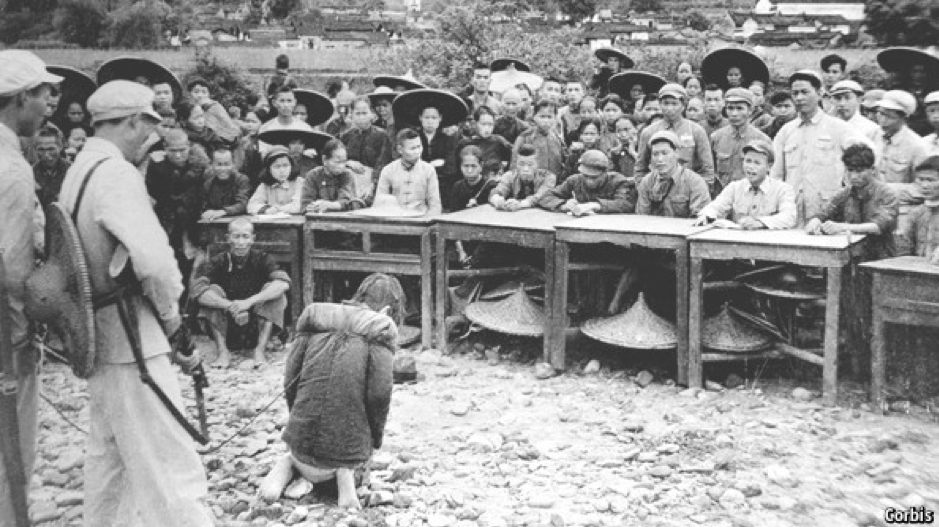
Eileen Chang witnessed firsthand the early stages of that campaign in the northern Jiangsu region. In her true-to-life novel Naked Earth, she depicts a moderately successful farmer, dragged in front of a jeering crowd with schoolchildren singing as he is harassed by members of the Farm Workers Association, the Women’s Association, and the Youth Vanguard Corps. He remains silent during his public shaming and beating. Eventually, he is crowned with a white paper cone-shaped cap emblazoned with the cue for his imprisonment: “Exterminate the Feudal Forces.”
The confiscation of land by the CCP and the negation of traditional land deeds were accompanied by the execution of potentially millions of landowners, seen as “class traitors” for earning more than their neighbors. Prior to their deaths, former property owners were publicly humiliated and beaten in shaming rituals known as “suku” or “Speaking Bitterness,” which served to “overturn” the social soil of rural life.
A rural court “tries” a bound landowner. John D Clare via Wikimedia Commons.
In June of 1950, Mao delivered a speech: “To Be a True Revolutionary.”
“War and agrarian reform are two tests everyone and every political party in China must go through in the historical period of New Democracy,” he thundered.
After the land seizures were complete, he proclaimed that every measure taken had produced a great victory for the revolution. Explaining his goals for this brutal “war,” he declared that the peasants who participated in the land seizures would “make the industrialization of the country possible.” What they truly made possible was their own demise.
The Great Leap Forward
Once land had been redistributed to the peasant class, what they thought belonged to them as “the people” was then claimed by the true owners: the centralized state. Initially, the rural poor received a Certificate of Land and House Ownership in 1952, which granted the legal right to farm, sell, transfer, and even bequeath it. The arrangement would be short-lived. Four years later, the People’s Congress promulgated the Model Regulations for Advanced Agricultural Producers’ Co-operatives on June 30, 1956. It forced all land rights to be yielded up to state-run collectives.
In early 1958, the Sixty Articles on Working Methods marked what could be considered the official declaration of the Great Leap Forward. The centralized planning was evident as the Sixty Articles called for party control of “a. targets of output; b. irrigation; c. fertilizers; d. soil; e. seeds; f. changes in the system of farming, such as enlarging the areas of a second crop” and even more.
At the center of this control was the fact that peasants no longer exercised decision-making: the farming communes were forcibly installed. What land the state had given, it would then take away. Secretly, some families hid their initial ownership certificates, perhaps in the hopes that they would one day be able to dispense with the property as they saw fit. That hope would be in vain. Instead, millions of them would starve to death.
The ultimate outcome of collectivized farming was a man-made famine. The mass starvation of 1959-1961 was triggered not by an act of Heaven, but rather as an inevitable consequence of the impossibility of rational planning under communist, centralized control. In a surprising contrast, the areas with the greatest productivity saw the highest rates of famine mortality. Production quotas were based on what regions had grown in the past, and when the harvest collapsed under low-productivity collectivism, the output quotas didn’t adjust the way a rational price system would.
When these minimums weren’t met, the Chinese central planners had two possible explanations. Either the plan was flawed, or peasants were hoarding the output. They incorrectly chose the latter. The only solution left to them was to forcibly search and seize what was on these farms and punish the offenders. The result was a catastrophic loss of life. Between terrifying violence and man-made starvation, scholars estimate between 16.5 and 45 million excess deaths.
While the famine’s death toll had begun to decline by 1962, its impact remained. The long-term health and economic outcomes were studied by Yuyu Chen and Li-An Zhou. They found that survivors born in 1959 were three centimeters shorter than they otherwise would have been, due to malnutrition. Yang Jisheng’s 2012 book, Tombstone: The Great Chinese Famine, 1958–1962 estimated a birth deficit of approximately 40 million, further depleting the future workforce.
Is America in danger of these kinds of Maoist tragedies? If the surging popularity of socialism among the young and the praise of Mao by the likes of Hasan Piker are any indication, then answering “yes” is entirely reasonable. Continual erosion of property rights, hatred of landlords, and other interventionist policies slowly, perhaps unintentionally, lay the philosophical groundwork for these devastating outcomes.
While some may lean on American exceptionalism to preserve our freedoms, they do so at their own peril. Socialist ideas and their implementation have left a merciless, relentless path of destruction around the world. Indeed, there are no exceptions to that rule.

