
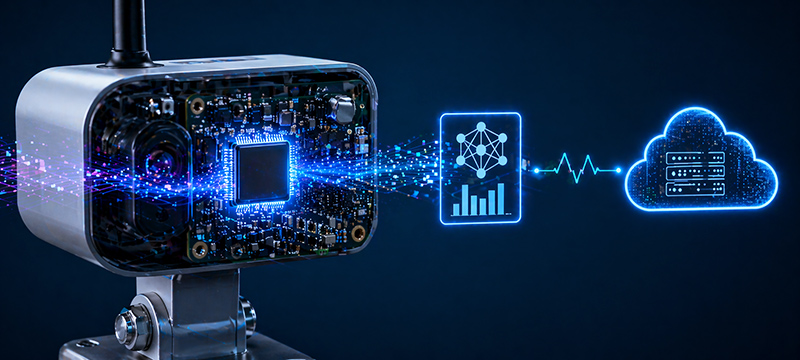
ModelBest and the OpenBMB community have released MiniCPM5-2B, a 2-billion-parameter open-source language model designed to bring tool use, multi-step reasoning and other agentic functions to resource-constrained edge hardware.
Edge AI has largely focused on running narrowly defined inference workloads close to where data is generated. The next challenge is more demanding: enabling devices to interpret requests, reason through multiple steps and invoke tools without continuously relying on a cloud-hosted model.
Chinese AI company ModelBest, working with the OpenBMB open-source community, is targeting that shift with MiniCPM5-2B, a compact language model intended for deployment across PCs, smartphones, robotics and IoT hardware. With 2 billion parameters, the model supports tool calling, deep search, code generation and multi-step reasoning, according to the company.
Moving agentic AI closer to the device
The notable aspect of the release is not simply that another small language model can run at the edge. ModelBest is positioning MiniCPM5-2B as a general-purpose agentic model rather than a model optimized for a single embedded AI task.
That distinction matters for IoT architectures. A conventional edge AI model might classify an image, detect an anomaly or recognize a spoken command. An agentic model introduces the possibility of coordinating several operations locally: interpreting a request, reasoning about the next action, interacting with software tools and producing a response.
In practical terms, this could move part of the device orchestration layer closer to the physical endpoint rather than keeping it entirely in the cloud.
ModelBest says MiniCPM5-2B can handle document processing, data synthesis, code generation and multi-turn question answering locally. The company also cites testing by Artificial Analysis in which the model ranked first on its Intelligence Index among open-source models below 4 billion parameters and received a score of 20 on the organization’s Agentic Index.
An open training stack, not just model weights
Another differentiating element is the scope of the open-source release. ModelBest and OpenBMB are publishing not only the model weights but also datasets, training recipes and reinforcement-learning infrastructure covering data curation, pre-training and alignment.
For developers building specialized edge applications, that could be more useful than a weights-only release. Access to the broader training pipeline provides a basis for understanding how the model was produced and potentially adapting the approach to domain-specific applications instead of treating the model as a fixed component.
The MiniCPM model family has accumulated more than 50 million downloads, according to ModelBest.
What it means for IoT deployments
For IoT OEMs and system integrators, the broader implication is that edge AI may increasingly extend beyond local inference into local decision workflows. Keeping more processing on the endpoint can reduce dependence on continuous cloud connectivity while limiting the amount of operational data that needs to leave the device.
That does not mean agentic AI will suddenly fit every IoT endpoint. ModelBest has not disclosed in the announcement the memory requirements, power consumption or hardware configurations needed for MiniCPM5-2B across different device classes. Those factors will ultimately determine where the model can be used in practice, particularly in embedded systems operating under tight compute and energy constraints.
The release nevertheless illustrates an important evolution in edge AI design. Rather than relying exclusively on ever-larger models running in data centers, developers are increasingly exploring how much reasoning and automation can be compressed into smaller models that operate close to machines and devices.
For the IoT sector, that evolution could eventually change the role of the edge from a place where predefined AI inference occurs into an execution layer where AI agents interpret local information and coordinate device-level actions. As discussed recently by IoT Business News in its analysis of AI agents becoming an IoT control plane, moving autonomous decision-making closer to connected assets also makes governance, permissions and operational safeguards increasingly important.
The post MiniCPM5-2B Brings Agentic AI Capabilities to Edge Devices appeared first on IoT Business News.
