
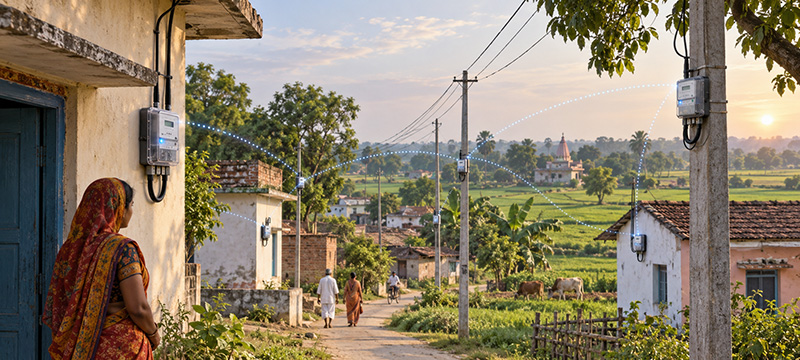
Nearly one million Polaris smart meters deployed in Uttar Pradesh are using Wirepas RF mesh connectivity, creating meter-to-meter networks that reduce dependence on cellular coverage and dedicated gateways.
Extending advanced metering infrastructure into rural areas creates a connectivity problem that looks very different from connecting meters in dense cities. Cellular coverage can become inconsistent, while deploying dedicated communications infrastructure across dispersed villages can add cost and operational complexity to projects that may already involve very large device populations.
That challenge is central to a smart metering deployment underway in Uttar Pradesh, where nearly one million meters supplied by Polaris Smart Metering are now operating with Wirepas RF mesh technology as part of India’s national smart metering programme. The state provides a particularly demanding environment: according to the companies, close to 78% of its population lives in villages.
The meters become part of the communications infrastructure
The defining feature of the deployment is not simply the use of wireless mesh, but the way connectivity infrastructure is distributed across the meter population. Instead of requiring a SIM card in every device or dedicated gateways serving groups of meters, Wirepas allows meters to communicate with one another and relay data through the network. Dual-communication meters can then use cellular connectivity where required.
This architecture changes an important aspect of AMI deployment economics. Adding another meter does not necessarily create another cellular subscription or require a new nearby gateway. It also adds another potential node to the mesh. In a geographically dispersed rollout, that means device density can contribute to network coverage rather than simply increasing the amount of communications infrastructure that must be provisioned.
That is what makes the Uttar Pradesh project distinct from many smart meter connectivity announcements. The deployment is using the meter estate itself as part of the access network, while retaining cellular as a complementary communications path rather than making it the default connection for every endpoint. Nearly one million meters are already operating with this approach in the state.
Why the architecture matters for large-scale AMI
For utilities and system integrators, removing dedicated gateways can simplify one part of the physical rollout, particularly where suitable gateway locations, backhaul or power cannot be assumed. It does not eliminate integration requirements: the communications layer still has to feed utility systems reliably and operate within the protocols used by the metering infrastructure.
Wirepas says its platform complies with DLMS and IS15959 requirements and can connect to Head End Systems through standardized APIs. The company also states that the technology is being used in more than 11 million smart meters across India under deployments associated with the Government of India’s Revamped Distribution Sector Scheme.
The practical implication is that connectivity choices for smart grids do not have to reduce to a binary decision between private infrastructure and cellular IoT. A mesh architecture combined with selective cellular backhaul offers another model: local traffic can move across a self-forming device network, while wide-area connectivity is introduced only at points where it is operationally useful.
A broader lesson for massive IoT deployments
Smart metering is particularly suited to this topology because deployments can involve large numbers of fixed devices distributed throughout the same service territory. Each additional endpoint can potentially improve the communications fabric around it. That differs from asset tracking or mobile IoT applications, where devices move independently and cannot necessarily depend on neighbouring nodes.
For meter OEMs, the approach can reduce reliance on integrating cellular connectivity into every endpoint. Connectivity providers face a different role, with cellular capacity potentially concentrated at selected points rather than attached to each meter individually. Utilities and integrators, meanwhile, gain an architecture designed to extend coverage organically as the meter population expands.
The Uttar Pradesh rollout therefore illustrates a broader consideration for massive IoT projects: the most appropriate wide-area network is not always one in which every device connects directly to external infrastructure. In sufficiently dense, fixed-device deployments, the endpoints themselves can become part of the network architecture.
The post Wirepas Mesh Connects Nearly One Million Smart Meters Across Rural Uttar Pradesh appeared first on IoT Business News.
