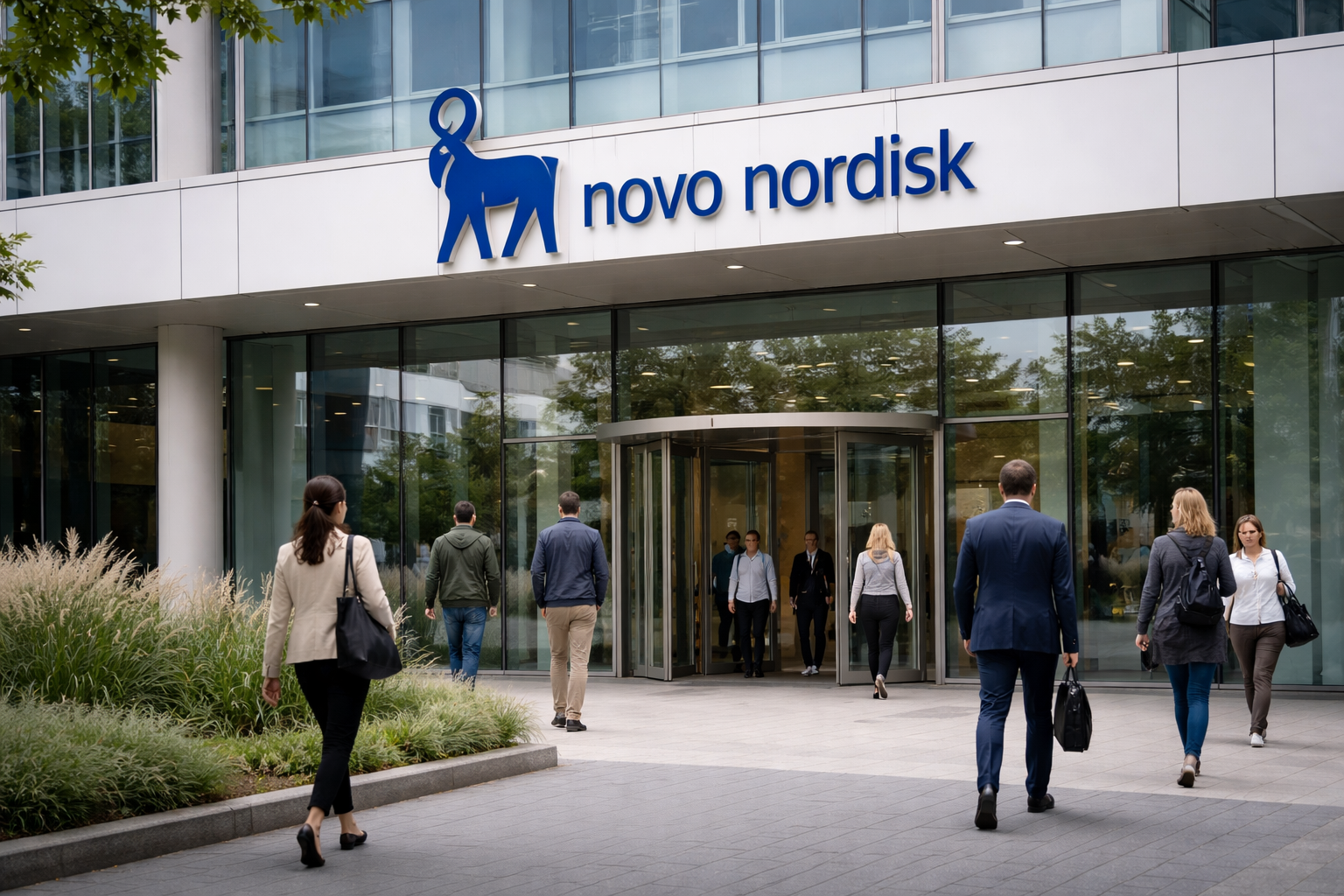
Novo Nordisk wants a bigger presence on Wall Street, and the timing may say more about the drugmaker’s challenges than the listing itself.
Chief executive Mike Doustdar said Novo could see advantages in replacing its American depositary receipts with shares listed directly in New York.
But the idea comes days after investors punished Novo’s latest growth strategy, with competition from Eli Lilly intensifying and questions mounting over what eventually replaces Ozempic and Wegovy.
Novo already depends heavily on America
Novo currently gives US investors access through ADRs traded on the New York Stock Exchange, while its primary shares are listed in Copenhagen.
Doustdar told the Financial Times that he sees advantages in replacing those ADRs with a direct NYSE listing, but stressed that Novo is not actively exploring the change.
This is not an IPO or primarily a capital-raising story. The stated objective is to raise Novo’s profile in the United States.
US operations generated about 56% of Novo’s 2025 sales, making American patients, payers and investors central to the company’s future.
Diabetes and obesity products also account for more than 90% of group revenue.
America is where its toughest competitive battle is playing out. Eli Lilly has gained ground in injectable obesity treatments, while Novo is betting heavily on pills.
Doustdar told Reuters this week that oral treatments could account for as much as 50% of the global obesity-drug market by 2030, well above some current Wall Street forecasts.
The timing exposes a harder investor question
The listing discussion comes immediately after a capital markets day that failed to reassure investors.
Novo outlined plans to launch at least five potential blockbuster medicines by 2030 and generate more than DKK150 billion, or about $23 billion, of risk-adjusted pipeline sales by 2035.
Yet the presentation did not erase concerns over slower growth, competition, pricing pressure and the eventual expiry of semaglutide patents.
Shares fell about 8% as investors questioned a medium-term growth ambition closer to the broader pharmaceutical industry than the exceptional expansion Novo once delivered.
AlphaValue analyst Abhishek Raval told The Wall Street Journal that Novo needs “aggressive and heavy diversification bets” alongside strong commercial execution because of its dependence on one molecule.
He nevertheless maintained a Buy rating, pointing to oral Wegovy, late-stage assets and acquisition firepower.
More visibility will not remove the patent cliff
A direct NYSE listing would not change Novo’s central investment questions: growth, competition and dependence on semaglutide.
Morgan Stanley recently downgraded Novo to Underweight, arguing that its valuation does “not entirely” reflect subdued medium-term growth or the implications of the semaglutide patent cliff.
The bank kept a DKK250 price target.
Analysts led by Thibault Boutherin forecast only 2% to 3% revenue and EBIT growth in 2027 and roughly 4% annual growth from 2027 through 2030.
Morgan Stanley estimates semaglutide could still represent 59% of sales in 2031, when loss-of-exclusivity effects begin to emerge.
That illustrates why the listing debate is secondary to execution.
Making Novo easier for American investors to own directly may raise its profile, but it does not diversify the pipeline, slow Lilly’s advance, or replace future semaglutide revenue.
The listing could improve visibility and liquidity, but cannot by itself repair confidence in Novo’s growth trajectory.
The post Novo wants to change how Wall Street owns its stock: why now appeared first on Invezz
