
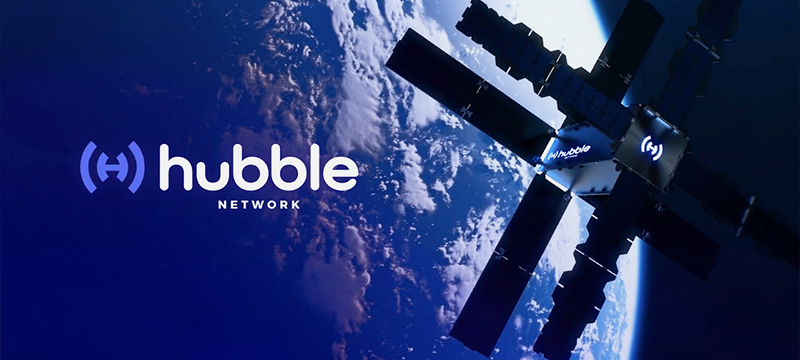
Hubble Network has moved its Bluetooth-to-satellite service into general availability, allowing compatible Bluetooth devices to communicate beyond terrestrial coverage without adding a dedicated satellite modem. The company has also raised $200 million to expand its low-Earth-orbit constellation.
Extending IoT connectivity beyond cellular coverage usually introduces a hardware trade-off. Devices operating in remote areas need a satellite-capable modem or another dedicated radio, adding cost, power consumption and integration complexity. That equation becomes particularly difficult for low-cost assets that only need to transmit small amounts of data.
Hubble Network is taking a different approach: using the Bluetooth Low Energy radio already present in many devices as the satellite communication interface.
The company has now opened its satellite network beyond its initial pilot customers, making the service generally available to companies using its network. According to Hubble, existing devices can gain satellite capability through a firmware update rather than additional communications hardware.
Turning Bluetooth into a direct-to-satellite link
The important distinction is that Hubble is not positioning satellite connectivity as another radio subsystem alongside Bluetooth. Instead, its architecture is designed to let a Bluetooth device communicate directly with satellites in low Earth orbit.
For IoT device makers, that could change the economics of adding connectivity outside conventional terrestrial networks. Hubble says that for new device designs, connectivity can add less than $0.50 to the bill of materials. The company contrasts this with dedicated cellular and satellite hardware, although actual deployment economics will naturally depend on the device, application and service requirements.
The approach is particularly relevant to asset tracking and low-data-rate monitoring. In these applications, the objective is often not continuous broadband connectivity but the ability to periodically report information such as location or sensor status when an asset moves beyond terrestrial network coverage.
This is also where Hubble’s model differs from many direct-to-device satellite initiatives. Rather than focusing on extending cellular standards to smartphones or IoT modules, Hubble is attempting to use the enormous installed ecosystem of Bluetooth-capable silicon as the endpoint.
A hybrid terrestrial and satellite architecture
Hubble is not relying exclusively on satellites. Its broader architecture combines a terrestrial network with its own LEO constellation. The company says its terrestrial footprint includes more than 100 million gateways across 170 countries, with more than 500,000 devices currently active on the network — more than ten times the number reported a year ago.
Companies already using the terrestrial network can extend compatible devices to satellite coverage through a firmware update, according to Hubble. New customers can also start with an off-the-shelf development kit connected through the company’s platform.
This hybrid model has an important practical implication. Satellite connectivity does not necessarily have to become the primary transport mechanism for an IoT device. It can instead operate as an extension of a lower-cost terrestrial Bluetooth infrastructure when assets leave gateway coverage. For logistics and mobile asset deployments, that potentially reduces the need to design separate connectivity architectures for connected and remote environments.
Samsara is among the companies that have tested the technology. The connected-operations provider has been working with Hubble on extending equipment visibility into locations where conventional network coverage is unavailable.
Constellation expansion becomes the next constraint
The satellite side of the network remains comparatively small. Hubble currently operates six satellites in low Earth orbit and plans to expand that number to 60 by 2030.
That makes constellation growth an important part of the technology’s evolution. Bluetooth-to-satellite communication may reduce endpoint hardware requirements, but the availability and frequency of satellite passes remain dependent on the orbital infrastructure supporting those devices. As a result, the suitability of the approach will vary according to how frequently an IoT application needs to exchange data.
Hubble’s newly announced $200 million Series C is intended in part to support that expansion. The round was led by Smith Point Capital, with participation from Seraphim, Carthona Capital, Earthshot Ventures, Y Combinator and RPM Ventures. It brings total funding in the company to $300 million and values Hubble at $1.6 billion.
For the wider IoT market, the significance lies less in adding another satellite network than in potentially changing which devices can use one. If satellite access can be delivered through existing Bluetooth silicon rather than a dedicated modem, direct-to-satellite IoT could move further down the asset-value chain — from expensive vehicles and equipment toward smaller tools, packages, sensors and other objects where traditional satellite hardware has been difficult to justify.
The post Hubble Network Opens Satellite Connectivity to Bluetooth IoT Devices appeared first on IoT Business News.
