
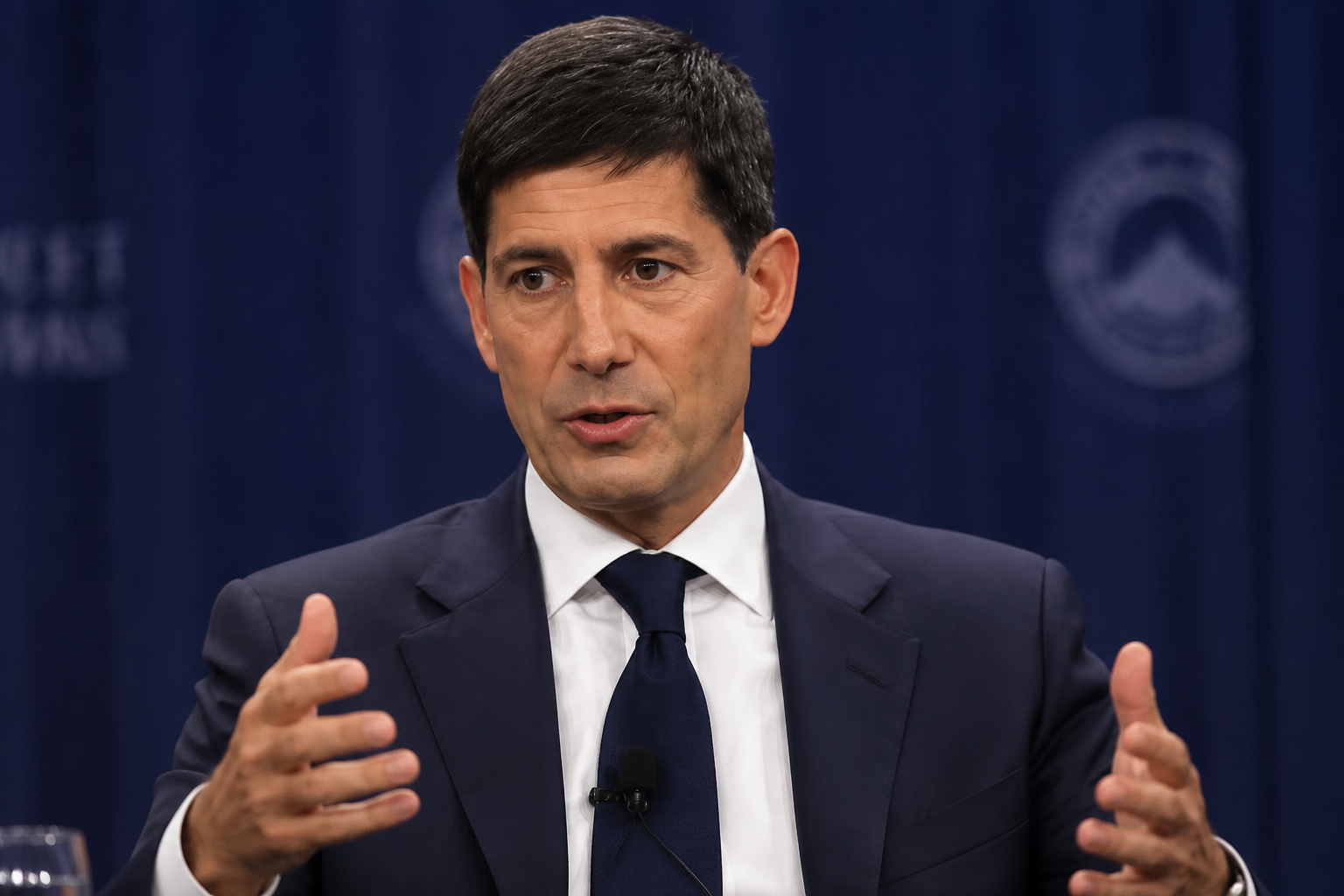
Federal Reserve Chair Kevin Warsh said Wednesday that monetary policy cannot directly lower oil prices or reopen the Strait of Hormuz, but argued that the central bank can prevent energy-driven price increases from spreading through the broader economy.
The comments came after the Federal Reserve raised interest rates by 25 basis points, taking the federal funds target range to 3.75% to 4%. The Federal Open Market Committee approved the move unanimously in a 12-0 vote.
US markets fell after the decision and conference as the Dow Jones fell 718 points while the S&P 500 declined 0.64% and the Nasdaq Composite was down 0.31%.
Bank stocks were among the biggest decliners, with Bank of America and Wells Fargo each falling 3%, while JPMorgan Chase slipped 1.9%.
The 10-year US Treasury yield hovered around the key 5% level.
The benchmark 10-year yield was little changed at 5.008%. Meanwhile, the two-year Treasury yield rose 5 basis points to 4.717%, reversing an earlier decline.
Warsh says Fed cannot control oil prices
Speaking at a press conference after the decision, Warsh acknowledged that higher interest rates cannot address supply-side disruptions affecting energy prices.
“We can’t affect any individual price, whether it be oil prices, whether it be foodstuffs at the grocery store,” Warsh said.
However, he added that the Fed would work to ensure changes in relative prices do not broaden into wider inflation.
Warsh said inflation remains the central bank’s predominant concern, arguing that price growth is still too high and has persisted for too long.
“The plain fact is that inflation is too high, and has been for too long,” he said in his opening remarks.
He added that recent summer inflation readings had not demonstrated a meaningful improvement in underlying trends.
Warsh pointed to CPI and PPI data showing too many categories still recording increases above 3% over six- and 12-month periods.
Fed signals further rate increases
The Fed’s latest projections indicated that another rate increase remains possible.
Sixteen of the 18 participants expect at least one additional increase, while four officials see the possibility of two more hikes.
Two participants expect policymakers to stop after Wednesday’s increase. Warsh has not submitted an individual dot since becoming chair.
Officials also projected one rate cut in 2028 and at least one more in 2029.
Warsh said the decision reflected several developments since the Fed’s July meeting, including a stronger economy, persistent inflation and changes in the geopolitical environment.
“There’s been a pretty wide ranging set of data, including the labor markets, that the economy has strengthened,” Warsh said.
He added that recent inflation trends had not met the Fed’s expectations for improvement and that the committee’s assessment of geopolitical risks had changed.
Data-centre spending adds to rate pressures
Warsh also pointed to large-scale spending on data centres by major technology companies as one factor contributing to higher long-term interest rates, alongside the strength of the US economy and geopolitical developments.
“The surge in capital expenditures is real,” he said.
The chairman also addressed concerns about the Federal Reserve’s independence.
Asked about communications with President Donald Trump, Warsh declined to provide details, saying, “I don’t have anything for you on discussions with the president.”
He said the Fed’s independence involves remaining within its policy remit while allowing policymakers responsible for trade and fiscal policy to operate within theirs.
Warsh also highlighted the impact of monetary stability on lower-income Americans, saying those “least well off” have the most to gain from sustained economic expansion, a strong labour market and stable prices.
The comments come as economists have described a divergence between higher- and lower-income households in the years following the Covid-19 pandemic, with lower earners tending to report weaker consumer sentiment.
The post Dow crashes 700 points as Warsh warns inflation is still too high appeared first on Invezz
