In 1993, my home state of Michigan enacted the Tobacco Products Tax Act, which raised taxes on cigarette packs from 25 to 75 cents per pack. Those were the highest excise taxes in the nation at that time. Michigan law still carries stiff penalties for tax violations, and anyone holding a pack without a Michigan stamp is liable for the tax, plus a penalty of five times that amount.
The smokers I knew back then started making late-night runs south of the border, to Indiana, where cartons were taxed at half the rate of the Great Lakes State. In a single, four-hour surveillance action, Michigan State Troopers recorded more than 180 Michigan-plated vehicles at just four Indiana party stores along Interstate 69. Indiana’s low-tax regime attracted the consumers in droves. Michiganders began voting with their feet, and the Hoosier State welcomed them with open arms.
A similar story is unfolding in the Land Down Under. The Aussies face a nationwide tax intended to reduce the health concerns of smoking, and packs are now averaging between A$40–$50 ($25-34 US). Each individual cigarette is taxed A$1.52, and the price of the habit has smokers choking.
Predictable second-order results are emerging. Underground markets supply packs for around A$13: the price difference presents huge profit opportunities for smugglers. Markets expanded quickly, and when more competitors tried to enter, sellers turned on each other. Over 200 arson attacks have been instigated among competing groups as of February 2026, with the majority of the fires set in tobacco shops in Melbourne. Demand hasn’t disappeared (about 8 percent of Australian adults smoke, comparable to US rates) so when prices tripled over 10 years, smokers simply sought out illegal sellers.
Australia’s tobacco-related firebombing is a case study in prohibition policies. When governments tax a legal product highly enough, consumers seek out low-price alternatives. The tax policy was meant to end smoking, but has instead produced lower tax revenues. Rates of use have not declined.
The Australian Bureau of Statistics more than 80 percent of tobacco Aussies consume is now black market. Their Border Force confiscated about 2.53 billion illicit cigarettes in FY 2025, as compared to 598 million in FY 2021, a remarkable 320 percent increase. The Australian states received A$23.4 million to police the trade.
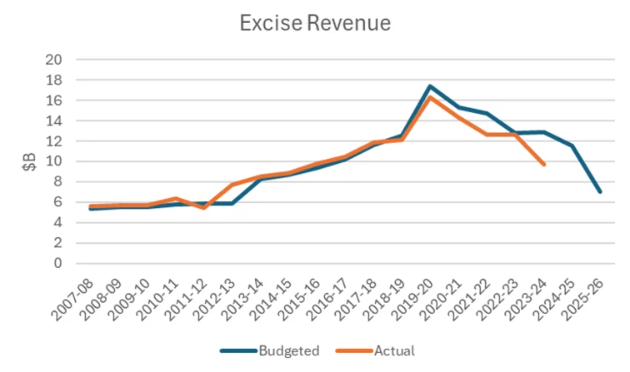
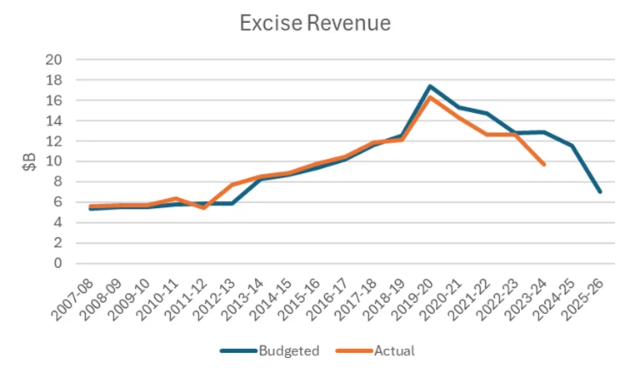
The tobacco excise tax raised A$16 billion in 2020, but took in just A$3.93 billion for FY 2026. These revenues have fallen as tax rates have risen. Recent reports expect tobacco tax revenue to decline by A$8 billion over five years.
Source: Center for Independent Studies
Theo Foukkare of the Australian Association of Convenience Stores, an industry group for the retailers losing legal cigarette sales, warns that without a repeal of the policy, there will be far less excise tax for the government to collect. Illicit sellers certainly won’t be filing tax returns either.
Mark Thornton’s 1991 The Economics of Prohibition anticipates these outcomes with remarkable detail. He portrays prohibition as a tax where enforcement creates risk for suppliers, and that risk raises prices, while cutting output. Thornton’s argument is that excise taxes and outright bans create similar incentive structures. Taxes can be used as indirect prohibition and Thornton described the consequences of this approach. He pointed to several economists:
Johnson (1978) provides additional evidence that…unit taxes result in higher prices than predicted by the traditional model of taxation. Harris (1980) also recognizes that increasing the per-unit taxes on cigarettes leads to a substitution of high-potency cigarettes for low-potency cigarettes.
Australian public health officials laud the new policy and report falling smoking rates as an important success. What the health record doesn’t address is how the tax persuaded smokers to seek out cheaper alternatives from unscrupulous actors. A crime wave has been set off: smuggling and money laundering are rampant, and rival sellers have firebombed over 220 locations in attempts to eliminate their competition.
Previous attempts to reduce smoking Down Under have included plain packaging, graphic health warnings, ingredient rules, age verification, and retail licensing, all of which have been applied to packaging. Four of five cigarettes smoked by Australians don’t have any of these features. Similar policies have been adopted to dissuade cigarette substitutes. Vapes were restricted to those acquiring medical prescriptions, and roughly 97 percent of e-cigarettes sold in the country were sold through illegal sources. That market alone is estimated to reach A$1.6 billion in total revenue and the regulations still persist. Officials govern a shrinking portion of the total trade: what ability they had to regulate tobacco products and their substitutes is going up in flames.
The futility of these efforts to eliminate Aussies’ smoking habits is on full display. Sin and excise taxes have always been tools to try to squelch behaviors that governments deem undesirable. But good intentions can’t negate the laws of economics. While they have done little to move the needle on public health, these punitive taxes have birthed or propped up dangerous criminal elements.
Salient parallels should give US policymakers reason to take heed. High-tax states have long been exploited by smugglers to generate higher profits, while treasury revenues dwindle. Neighboring states that keep taxes low see their coffers expand, as those wishing to stay on the right side of the law drive across borders for marginally lower prices. Australia, just like Michigan, couldn’t stop people from smoking, but in both cases, tax revenues collapsed. The pain is even worse in the Aussies’ case, as violent underground actors have responded to the incentives created by governing authorities.