
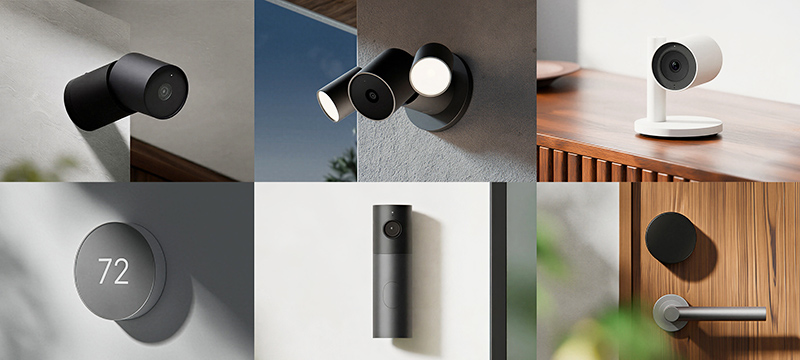
LG Electronics and Apple have jointly developed seven smart home accessories spanning security, access control and climate management. The new product range combines Apple Home integration, coordinated device controls and Matter over Thread connectivity for selected devices.
A smart lock, security camera and thermostat may all connect to the same home platform, yet coordinating their actions is not always straightforward. Setting up routines, managing privacy settings and ensuring devices respond consistently often requires users to navigate different controls and configurations. Bridging these gaps remains a key challenge for the smart home industry.
LG Electronics and Apple are taking a more integrated approach with a new collection of seven smart home accessories developed jointly from the initial product planning stage. Announced on October 13, the lineup includes indoor and outdoor security cameras, a video doorbell, smart lock, thermostat and temperature sensor, all designed to operate within the Apple Home ecosystem.
Unlike conventional third-party accessories that simply support an existing smart home platform, the new devices have been co-developed across hardware, software and user experience. The collaboration brings together LG’s expertise in connected home appliances and Apple’s home automation platform, with the objective of simplifying interactions between connected devices.
From Device Compatibility to Coordinated Automation
The distinction matters because smart home integration increasingly extends beyond connecting individual devices to an application. Users expect multiple products to respond consistently to shared routines, environmental conditions and occupancy patterns.
LG and Apple illustrate this approach through coordinated Apple Home scenes. A single morning routine, for example, can adjust the thermostat while automatically tilting an indoor camera downward to provide privacy when monitoring is unnecessary.
The accessories support control through the Apple Home and LG ThinQ applications, with Siri enabling voice-based interactions. An Apple home hub, such as a compatible HomePod or Apple TV 4K, is required, alongside Wi-Fi connectivity.
This architecture also highlights an important consideration for the wider smart home industry: close integration can simplify the user experience while increasing dependence on a particular ecosystem. For device manufacturers, the trade-off involves balancing platform-specific functionality with interoperability across competing smart home environments.
Security and Access Control Take Center Stage
Four of the seven devices focus on home monitoring and entry-point security.
The LG Indoor Cam Plug-In provides a 160-degree field of view and includes a physical privacy mechanism that tilts the camera away when monitoring is not required. The Outdoor Cam Plug-In supports 2.5K video resolution and color night vision, while the Floodlight Cam combines video monitoring with adaptive outdoor lighting triggered by detected activity.
Across the camera range, intelligent detection can distinguish people, pets, vehicles and movement. Users can define areas excluded from recording, and built-in local storage provides an alternative for managing recorded footage.
The LG Video Doorbell Wired uses two cameras: a 2.5K front-facing camera and a Full HD downward-facing camera. This arrangement allows separate monitoring of visitors and packages, while supporting two-way communication and event notifications.
For physical access, the LG Smart Deadbolt Lock combines Ultra-Wideband technology with Apple’s home key functionality. Compatible iPhones and Apple Watches can provide hands-free unlocking based on the authorized user’s proximity and movement. NFC, PIN entry and a conventional physical key offer alternative access methods.
Security extends to the underlying platform. According to the companies, accessories use end-to-end encryption within Apple Home, with camera footage and personal data inaccessible to both LG and Apple.
Matter over Thread Supports Connected Climate Control
The thermostat and temperature sensor introduce a different connectivity dimension to the collection.
The LG Smart Thermostat works with Apple’s Adaptive Temperature functionality to adjust heating and cooling according to whether occupants are home, away or sleeping. Additional LG Temperature Sensors can provide temperature and humidity measurements from different rooms, enabling more distributed climate monitoring.
These devices incorporate Matter over Thread, combining the Matter interoperability standard with Thread’s low-power mesh networking capabilities.
For IoT device developers, this is a notable architectural choice. Thread is designed for low-power devices that exchange relatively small amounts of data, making it suitable for distributed environmental sensors. It also provides a different networking model from the Wi-Fi connectivity typically used for bandwidth-intensive products such as cameras.
The thermostat also supports energy-aware operation. In the United States, Apple’s Clean Energy Guidance can help optimize consumption according to grid carbon intensity, while supported utility integrations allow operation to shift toward lower-cost electricity periods.
Implications for the Smart Home Ecosystem
The LG-Apple collaboration illustrates two approaches developing alongside one another in residential IoT: tighter vertical integration at the user-experience level and standardized connectivity at the device-networking level.
Matter over Thread provides a standards-based foundation for selected accessories, but the overall experience remains closely associated with Apple Home. Support for a common connectivity standard should therefore not be confused with universal availability of every automation, privacy or access-control feature across different platforms.
For smart home device manufacturers and system integrators, the announcement reinforces the importance of considering connectivity, platform integration and user experience as interdependent design decisions rather than separate development stages.
The seven-device collection will begin launching in the United States and Canada in December 2026, with selected accessories following in early 2027. In the United Kingdom, the initial December release will cover indoor and outdoor cameras and the video doorbell.
The post LG and Apple Co-Develop Seven Smart Home Devices with Integrated Controls and Matter Support appeared first on IoT Business News.
