
Introduction
Many people probably assume that Congress, like a household, sits down once a year, takes an accounting of how much money is likely to come in, and then determines how much money it can afford to spend. This might have been how Congress used to operate and how the federal budget is supposed to work on paper. In practice, however, Congressional budgeting works much differently.
At its core, a budget — whether for a household or a government — is an acknowledgement that the desire to spend money exceeds the ability to spend it. This difference necessitates prioritizing some spending while setting other things aside. However, while a family can settle budgetary questions at the dinner table, Washington uses a year-long relay race involving the White House, more than 20 committees, and both chambers of Congress, each of which has its own set of deadlines, procedural rules, and incentives.
This explainer will lay out the federal budget relay race process. It examines the process that takes a proposed spending plan from a wishlist to an actual check while operating under rules designed to keep total spending in line.
The federal budget process is governed primarily by the Budget and Accounting Act of 1921 and the Congressional Budget and Impoundment Control Act of 1974. This explainer summarizes the most important parts of those laws. Some details are left aside for sake of brevity. For a more complete version of this process and its nuances, see Allen Schick’s The Federal Budget: Politics, Policy, Process.
Step One: The President Asks
The budget process begins about 18 months before the budget takes effect. As an illustration, this explainer was written in the summer of 2026. At that point, the budget process for FY2028 — which begins on October 1, 2027 — is already underway. Each spring, the Office of Management and Budget (OMB), in its capacity as the President’s in-house budget lab, sends planning guidelines to federal agencies. These guidelines lay out the administration’s priorities and provide direction as to what it hopes to accomplish. The agencies then build their specific requests around those guidelines and send them to OMB in the fall, about a year before the budget takes effect.
OMB then begins a “fall review,” assembling each agency’s requests and comparing them with the President’s priorities and the resources likely to be available. Agencies can contest OMB’s decisions about their requests, but ultimately the President must submit the administration’s budget request to Congress no later than the first Monday in February(about seven months before the budget will go into effect), when the President must send the finished budget proposal to Congress. In 2026, for example, President Trump did not submit his FY2027 budget request until April, a full seven weeks later, causing controversy.
At this point, the President’s budget proposal is just that: a proposal. It lays out the administration’s priorities and provides a detailed plan for how the government intends to allocate resources. But per Article 1, Section 8 of the Constitution, Congress holds the ultimate power of the purse. The President’s budget proposal is not legally binding; it is little more than
Step Two: Congress Writes the Blueprint
Once the President’s budget request arrives, the House and Senate Budget Committees begin their work. The Congressional Budget Office(CBO) is given an opportunity to weigh in with its own analysis of the economic outlook to Congressional budget committees by mid-February. The committees with spending jurisdiction then submit their own “views and estimates” within six weeks.
The Budget Committees are supposed to report a budget resolution by April 1, with Congress required to complete the passage of there solution by April 15. Again, these dates are all set out in law. However, Congress has only met these deadlines four times since the passage of the Congressional Budget and Impoundment Control Act of 1974: 1977, 1989, 1995, and 1997.
The budget resolution is a blueprint defined by two features. First, it is a concurrent resolution, which means that both chambers of Congress must agree to the same version. Because it is a resolution rather than a law, however, it does not require the President’s signature. It is also important to note that the budget resolution, by itself, does not spend any money. Instead, it creates a framework for subsequent spending, revenue, and other budget-related legislation.
Second, the budget resolution works in aggregate terms rather than programmatically. It sets total spending and revenue targets for the coming decade, divides spending across roughly 20 different categories, and lays out four required totals: revenue, spending, the resulting deficit or surplus, and public debt. The resolution may also include reconciliation instructions, which direct committees to develop legislation to bring spending or revenue into line with the budget’s targets.
Here, it’s worth mentioning some particular quirks to this process that are unique to the US Senate. After the Senate’s Budget Committee reports the resolution to the full Senate, a debate period begins. Under Senate rules, debate is limited to 50 hours. Senators can offer amendments during this period that are germane to the resolution, which means that they can strike a provision or change a number or date but cannot add unrelated topics. At the end of this debate period, the Senate holds a rapid-fire series of amendment votes, colloquially known as “vote-a-rama.” These votes are “up or down,” meaning that the Senators either approve the amendments as written or they do not. This process can sometimes go through the night.
The reconciliation instructions allow for a process known as “budget reconciliation.” Under these rules, Senate committees can draft legislation that brings spending or revenue into line with the budgetresolution’s targets. That legislation then moves directly to the Senate floor, meaning it does not require the usual 60-vote cloture and can be passed with a simple majority.
This makes budget reconciliation a powerful legislative tool. Because reconciliation legislation can pass the Senate with a simple majority, the Senate has placed limits on what it can contain through the Byrd Rule, which allows the sometimes maligned Senate Parliamentarian to advise the presiding officer to strike any provision deemed“extraneous” to the budget. The One Big Beautiful Bill Act, for example, was passed using budget reconciliation.
Finally, once the House and Senate pass identical language, Congress has completed the budget resolution. Comparing this to a household, Congress has now created the equivalent of a spreadsheet that contains broad spending categories like “vacation fund” and “housemaintenance/repairs,” along with the amounts it plans to allocate to each. It has not authorized the government to cut checks. The budget resolution provides the framework; the spending bills come next.
Step Three: The Appropriators Begin Their Work
Where the resolution determines how much money will be spent in service of broad categories, the Appropriations Committees determine how much money will be allocated to specific projects within those categories. To do this, they divide the work among their various subcommittees, each of which has jurisdiction over particular aspects of the government. In both the Senate and the House there are twelve such subcommittees. Each writes a spending bill for its area, subject to the spending limits established by Congress.
At this stage, two distinctions can confuse even careful observers. The first is between authorizing and appropriating. An authorization bill creates or continues a program. Sometimes, an authorization bill will contain a dollar amount. However, authorization bills do not actually provide money to spend. An appropriations bill does that. A program can therefore be fully authorized but still unfunded, which is why a program can be on the books but simultaneously starved of cash.
The second distinction is between regular appropriations and supplemental appropriations. Regular appropriations provide funding for the upcoming fiscal year and must be enacted by October 1 when the fiscal year begins.
If Congress misses that deadline, it can pass a continuing resolution to temporarily extend the prior year’s funding levels until the new, regular appropriation bill is passed. If Congress fails to pass a continuing resolution, affected agencies may shut down. Supplemental appropriations provide additional funding for needs that arise during a fiscal year, such as disaster relief, and have no fixed deadline.
The final point is that the appropriations committees only control what is known as discretionary spending. For FY2025, discretionary spending totaled $1.9 trillion, which is about 27 percent of the total budget that year. Non-discretionary spending totaled about $5.1 trillion and includes mandatory spending on programs such as Social Security, Medicare, and Medicaid, as well as net interest payments on the national debt.
In other words, most federal spending isn’t actually on the table for discussion. It is governed by existing federal law.
Financing the Spending
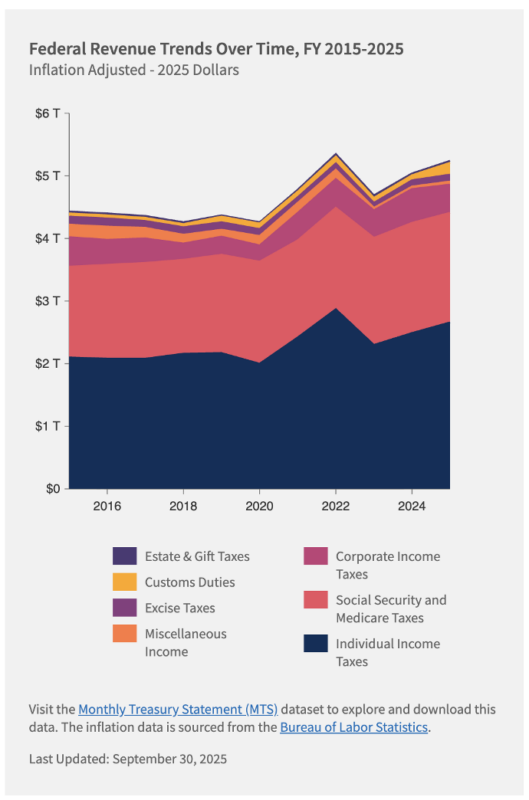
Spending money is one aspect of the federal budget. But where does the federal government get the money that it actually spends? The Treasury provides the following figure to help visualize where federal revenue comes from.
Figure 1
The bulk of federal revenue comes from two sources: individual income taxes ($2.66 trillion for FY2025) and Social Security and Medicare taxes($1.75 trillion). All told, for FY2025, the federal government collected $5.23 trillion in revenue. Their spending for that year was $7.01 trillion. This raises the obvious question: in a world where spending exceeds revenues, how does Congress cover the difference?
When federal spending exceeds revenue, the Treasury must borrow money. How much money they are allowed to borrow is determined by what is known as the debt limit.
The debt limit is a relatively modern invention. At the founding, the Constitution did give Congress the power of the purse, but it did not create a standing line of credit for the government to draw upon. When the government wanted to borrow, even to finance major projects like the Louisiana Purchase or the Panama Canal, Congress had to authorize those debts through “project-specific debt authorization.”
During the First World War, Congress needed to raise money quickly and repeatedly. Finding project-by-project authorization too slow and cumbersome, Congress passed the Second Liberty Bond Act of 1917. This law established the aggregate “debt limit” of $11.5 billion. Rather than having to approve each debt on its own terms and weigh individual borrowing decisions, Congress effectively set an overall ceiling and let the Treasury borrow up to it as needed. What began as temporary wartime flexibility became the permanent vehicle for federal borrowing.
The debt limit does not authorize spending or create any programs. It merely allows the Treasury to issue debt to finance spending authorized and appropriated by Congress. Because the government runs a deficit in nearly every year, its accumulated debt routinely approaches the debt limit. Then Congress must either 1) raise the limit, 2) temporarily suspend the limit, or 3) renege on spending commitments it has already made.
The debt limit functions like the credit limit on the government’s credit card. Unlike a personal credit card’s spending limit, however, Congress’s debt limit is entirely self-determined. Congress can, and does, raise the debt limit.
Continuing Resolutions and Shutdowns
What happens if Congress does not enact its regular appropriations bills by October 1? In this scenario, Congress can pass a “Continuing Resolution” (CR), essentially giving itself more time to pass regular appropriations bills while continuing to fund the government at previously agreed-upon levels. If it cannot pass a CR, then the affected agencies enter into a “government shutdown.”
The government shutdown is a surprisingly recent creation. Two legal developments produced it. As previously mentioned, the 1974 Budget Act created the deadlines Congress is supposed to meet. The second is a1980 opinion by Attorney General Benjamin Civiletti interpreting the Antideficiency Act.
The Antideficiency Act forbids federal agencies from spending or obligating money that Congress has not appropriated. The original intent of the law was to solve a different problem. Agencies would frequently spend their entire annual budgets in the early months of the year, thereby creating a “coercive deficit,” compelling Congress to either appropriate more funds or watch essential functions, such as national defense, shut down due to lack of funds.
Prior to 1980, agencies would treat a lapse in appropriations as a technicality and keep operating on the assumption that Congress would eventually backfill the money they needed. Civiletti’s opinion was that the Antideficiency Act meant that when appropriations lapsed, affected agencies are prohibited from continuing non-essential operations and from incurring new obligations without a legal or emergency exemption that says otherwise. In other words, a statute originally written to keep the executive branch from overspending became the mechanism behind the modern shutdown.
“Government shutdowns” didn’t exist prior to 1980, at least not in the modern sense. This helps explain why a large majority of federal spending continues even during a shutdown: most federal spending is “mandatory” and runs on permanent law rather than annual appropriations. Social Security, Medicare, and interest on the debt, for example, are all paid without interruption during a shutdown.
Similarly, functions that are deemed essential, such as the bulk of national defense, continue operating. Non-essential discretionary activities — national parks, the Smithsonian, and parts of civilian agencies — all send their workers home.
Frequent shutdown drama results from a deeper habit: Congress’s reliance on stopgap funding. Since 1977, the first year that the Budget Act of 1974 took effect, Congress has passed more than 200 continuing resolutions instead of completing appropriations bills. The Government Accountability Office has documented the uncertainty and inefficiency this creates for the agencies that must operate under them, including delayed hiring and duplicated contracting work, ultimately costing taxpayers more money in the long run. The funding fight gives both parties an opportunity to raise money, mobilize supporters, and vilify the other side, which is, in part, why spending deadlines so frequently become political crises.
Is the Budget Process Still Working?
This explainer highlights the wide gap between how the budget process is supposed to work and how it actually works. On paper, the process is clear and orderly. The President submits a proposal, the Budget Committees set the totals, and the Appropriations Committees divide the money among specific programs. Explicit statutory deadlines should keep everything moving toward an October 1 finish line. Unfortunately, Congress has reached that finish line on schedule only four times since 1974.
The gap between what is “on paper” and what happens “in practice” shows that a deadline carrying no penalty for missing it is little more than a suggestion. A borrowing limit that the same body can raise whenever it becomes inconvenient only restrains that body for as long as it wants to be restrained.
Then there is the matter of the proportion of discretionary spending relative to mandatory spending. The annual fight toward the end of the fiscal year, complete with shutdown deadlines and dueling press conferences, concerns only about a quarter of federal government spending. The rest, such as entitlement programs and interest payments on the debt, lies completely outside this process under permanent law and is rarely discussed.
What should be clear from this explainer is that federal budgeting is a much more complicated task than household budgeting. This complication is not due to the amount of money being spent, but stems from the process of determining how much money to spend, on which specific projects, and when. When policymakers claim to have passed a budget, or, more commonly, a continuing resolution, this is really just the start of a long process.
The federal budget process is elaborate in its design, improvisational in its implementation, and largely silent about most of the money Congress spends. Understanding this process helps clarify the fiscal dysfunctions that come from Washington.
