
In January 2002, shortly after the launch of the Starbucks Card, Michael Casey was its CFO and he reportedly gave a novel description of how Starbucks would use those funds. According to Allen Eslekin, the original Starbucks Card program manager, Casey was elated: the program represented “a $20 million interest free loan from our customers” that would reduce their reliance on banks for loans and operating cash.
In 2019, AIER contributor J.P. Koning reiterated this illustration in his Moneyness blog. There, he explained that balances on gift cards amounted to $1.6 billion and “simultaneously function as a loan to Starbucks,” and customers are “providing the company with free debt.”
Not all writers agree with this analogy, however. Patrick McKenzie, who has done a deep dive into the economics of gift cards, characterizes Starbucks’ strategy differently. He says that the float model is “not a terrible mental model” but it “breaks down in the details.” McKenzie is careful to characterize gift cards as a prepaid balance.
Lenders of money expect dollars back. Not so with a Starbucks gift card. The terms for a gift card purchase make it clear that the balance is “nonrefundable” and that it “may not be redeemed for cash,” unless required by law. What is owed is coffee or other Starbucks merchandise of the holder’s choice at an uncertain location sometime in the future. The company’s website further explains: “The dollar value that you load onto your Starbucks Card is a prepayment for the goods and services of participating stores.”
According to their Q3 2026 SEC filing, Starbucks holds over $1.8 billion in “stored value card liability and current portion of deferred revenue.” This means that card balances don’t count as revenue until customers redeem them. The figure is on the liability side of their balance sheet. What Casey called a $20 million interest-free loan in 2002 has grown more than ninetyfold.
There is an important difference between customers providing a firm with an interest-free loan and deferred revenue. If a customer wishes to loan money to a corporation, they can do so with a bond. While a bond and a prepaid balance both hand a company money today, that is where the similarity ends. Bonds are repaid in dollar units on a date both sides agree to at an agreed-upon interest rate. A stored gift card balance is another matter. It is redeemed at an unknown time, an unknown location, for mostly unknown goods.
The economy of gift cards must also grapple with another reality: lost and forgotten cards. “Breakage” is the accounting term for those cards that are lost in the back of your kitchen junk drawer or that slid between your bucket seats. There is a line on Starbucks’ income statement that acknowledges that deferred revenue doesn’t come in. In FY 2025 it recognized over $200 million in lost cards for its company-operated store revenues and another $22 million through licensed stores. That amount is then shifted from a liability and into the revenue column.
When customers load dollars onto gift cards, Starbucks estimates that some percentage of those balances won’t be redeemed for coffee and then counts that estimate as revenue. There’s no cost associated with this move either. If the card isn’t redeemed, there’s no coffee, no cup, no oat milk, and no barista paid to serve non-redeemed coffee. That $222 million was roughly eight percent of Starbucks’ $2.9 billion in operating income for that fiscal year.
What breakage can’t do is produce cash. What it can do is to goose the earnings reports that shareholders and banks use to assess investment and lending decisions. In FY 2025, Starbucks’ operating cash flow fell by 22 percent compared to the previous year. After its capital expenditures, Starbucks paid out $2.77 billion in dividends against $2.44 billion in free cash flow and had no stock repurchases.
SEC filings that provide a corporation’s financial inner workings are detailed and require some understanding of corporate accounting principles to discern. One thing that isn’t revealed in any of Starbucks’ findings is what breakage revenues are used to fund. What is certain is that they aren’t taking initial payments on gift cards and growing them over time. In a very real sense, the longer you hold onto a gift card, or it goes undiscovered in your center console, the less coffee it will buy.
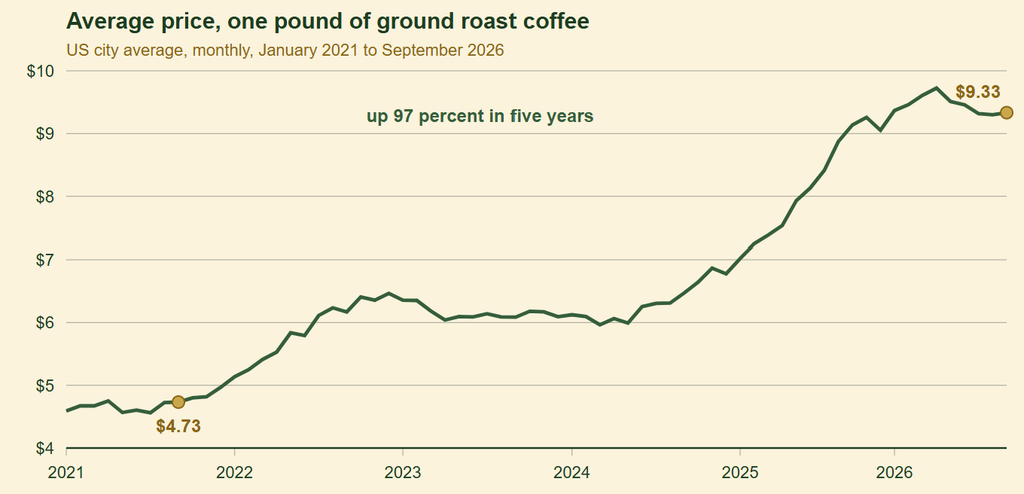
The Bureau of Labor Statistics (BLS) coffee index stood at 201.8 five years ago. Today, it’s at 299.1. In terms of prices, a pound of ground coffee has surged from $4.73 in September 2021 to $9.33 five years later. What’s striking about these numbers is that coffee prices have gone down since the outbreak of the conflict with Iran. This isn’t a story about surging fuel and shipping costs, but one about long-run decreases in purchasing power.
Source: Bureau of Labor Statistics (APU0000717311)
In this inflationary environment, holding a Starbucks gift card subjects one to an inflation tax. Prepaid cards experience a loss of purchasing power in the same way that holding cash balances do. Two years ago, that $25 gift card may have purchased five drinks at $5, but now may only get you four at $6.25 each. Starbucks isn’t responsible for the ongoing price inflation for all the costs that go into producing a cup of joe. Coffee lovers are getting less bang for their buck and it isn’t primarily due to the Iranian oil shock. This is a longer-run story of continual credit expansion through the Federal Reserve system and its banks. Every new dollar erodes the value of those already in your pocket — even those stored on Starbucks gift cards.
