Senators elected in 2026 will confront Social Security’s trust fund depletion before their terms end. If they choose not to act, the law limits Social Security spending to incoming revenues once all trust fund IOUs have been redeemed. To avoid politically unpopular benefit and tax changes, some politicians are now suggesting that continued borrowing could be an option.
Sen. John Kennedy (R-LA), for example, told supporters at a recent event: “Your Social Security is safe. You can write that down and take it home to mama. […] All we got to do is go take the money out of the general fund, which we always do.”
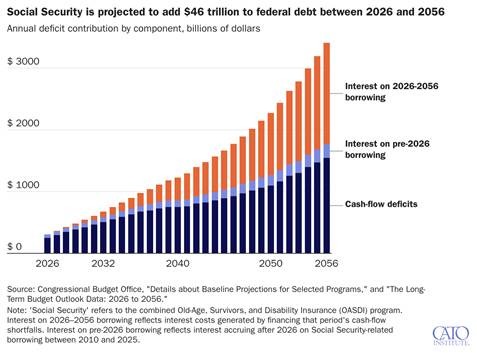
The problem that Senator Kennedy overlooks is that there is no money to cover Social Security’s shortfall in the ‘general fund’ either. The general fund is running a roughly $2 trillion annual deficit that is projected to grow to $3 trillion over the next 10 years. In 2032, the year Social Security’s trust fund is projected to be fully depleted, the general fund deficit is projected to total $2.4 trillion, with Social Security’s shortfall accounting for $680 billion of that amount. Taking “the money out of the general fund” therefore means adding to the deficit and the national debt.
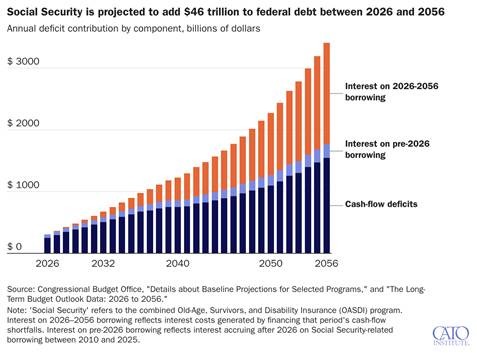
And that choice would get expensive quickly. Social Security’s shortfall is projected to grow at an average rate of 8.3 percent a year, adding roughly $46 trillion to federal debt between 2026 and 2056. That would amount to about 34 percent of projected debt growth over those three decades.
If Senator Kennedy has his way, Social Security would become a major driver of future debt growth, alongside Medicare spending and interest on the massive and growing federal debt.
On the bright side, borrowing more to fund Social Security would eliminate the trust fund depletion date and the prospect of automatic benefit cuts of 22–28 percent that the deadline entails. This is what makes borrowing an attractive option for politicians who would rather avoid talking about reducing benefits or raising taxes. But it would also compound Social Security’s liabilities for taxpayers, as the program’s financing shortfall continued to grow and accumulate interest.
And these estimates do not account for the likely prospect of an economic crisis or other expensive emergency between now and 2056. As Jason Fichtner and Veronique de Rugy have argued, borrowing to fund Social Security beyond 2032 could itself trigger a negative reaction in bond markets. Bond investors might view Social Security’s trust fund depletion as an inflection point: Will Congress use statutory triggers like Social Security’s depletion date to address the nation’s unsustainable fiscal trajectory, or wait for bond markets to force corrective action?
The costs of borrowing to fund Social Security would not remain confined to the federal budget, either. More government borrowing competes with private investment, puts upward pressure on interest rates, and can leave workers with less capital and lower wages. CBO estimates that GDP would be about 1 percent higher in 2036 if Social Security benefits were reduced to align with projected payroll tax revenues, rather than Congress authorizing additional borrowing. Abrupt benefit cuts in 2032, as scheduled under current law, could be painful and poorly targeted. But CBO’s comparison exposes a fact politicians prefer to ignore: Borrowing has real costs, too.
Borrowing to avoid retirement program reform can also create a negative feedback loop: Higher debt suppresses investment, lower investment depresses growth, and weaker growth reduces payroll tax revenue. The result is that debt financing could widen the Social Security shortfall while fueling the growth of the national debt.
The only way out of this vicious cycle is for politicians to finally bite the bullet and align benefit promises with what taxpayers and the economy can afford. If legislators act soon, they could phase in structural reforms gradually, slow the growth of future benefits, reduce benefits for higher-income retirees, protect the most vulnerable seniors from abrupt benefit cuts, and encourage younger workers to save and invest more on their own to prepare for smaller Social Security checks down the road. Waiting until 2032 would leave legislators with fewer options, forcing either more abrupt changes or adding greater pressure to borrow.
Short of political courage, Congress could delegate the unenviable task to a powerful fiscal commission. The Base Realignment and Closure commission model could offer one approach to restructuring entitlement programs and slowing the growth of federal debt.
There is no painless option. But there is a profound difference between reforming Social Security deliberately and pretending that another $46 trillion in debt is a solution. Congress can reduce Social Security benefits gradually and predictably, or it can force younger workers to finance unsustainable promises that grow ever larger through higher taxes today or tomorrow.
Avoiding politically difficult benefit reductions and tax increases will not make Social Security sustainable. Additional borrowing merely kicks the can further down the road — and adds to the bill with interest.
There is no escaping this fundamental fiscal fact: Today’s debt increase is tomorrow’s taxpayer burden.