
Barriers to Entry and Broken Promises
1. The Origins and Rise of Certificate of Need Laws
Certificate of Need (CON) laws are state-level regulations that require entrepreneurs, healthcare systems, and nonprofit organizations to obtain government permission before building new facilities, expanding existing ones, or offering new medical services. Before a hospital can add beds, before a nursing home can open its doors, before a surgery center can install an MRI machine, each must first satisfy an administrative board that the new capacity is “needed.” In the 39 states and Washington, DC that impose these restrictions, incumbent healthcare providers that stand to lose business from new competitors can participate in the approval process and, in some cases, block new entrants.
This explainer traces how CON laws came to exist, what they were designed to accomplish, and what the record shows they have actually done. It draws on the legislative history of the National Health Planning and Resources Development Act of 1974, the subsequent decades of state-level experience with CON boards, and a growing body of peer-reviewed research on their consequences.
Certificate of Need boards have been a cartelizing force and a policy failure, 80 years in the making. While the benefits of these politically created restrictions have been concentrated among incumbent healthcare providers, the costs have been dispersed across society, including through higher Medicare and Medicaid expenditures. Those costs, however, have become too great for the public to ignore.
One of the earliest articulations of the ideas that gave rise to Certificate of Need laws emerged in the mid-1940s.[1] With the Truman administration’s support, Senators Robert Wagner (D-NY), James Murray (D-MT), and John Dingell Sr. (D-MI) proposed the National Health Bill, which sought to ensure access to doctors and hospitals regardless of income and use federal funds and national standards to expand hospital construction, particularly in rural areas.[2]
Truman also proposed expanding medical schools and the number of doctors while using central planning to cap physician wages. The American Medical Association (AMA) opposed these efforts, ostensibly to protect doctor quality and expertise, though limiting physician supply also protected incumbent practitioners from lower-wage competition.[3]
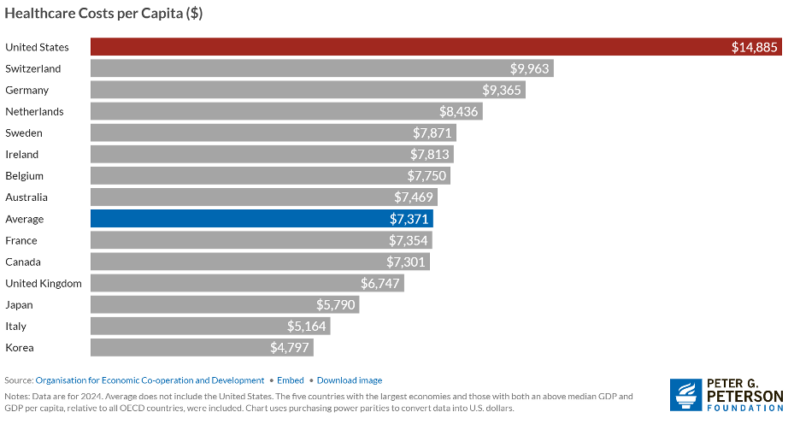
Chart 1: US vs OECD Healthcare Costs per Capita
Eventually, the AMA’s lobbying power would block Truman’s proposals. Frustrated by this initial outcome, Truman would later lament, “I have never been able to understand all the fuss some people make about government wanting to do something to improve and protect the health of the people.”[4] Nevertheless, the seeds had been sown for centralized control of health services. Ultimately, it would become clear that these public claims were political speak for quantity controls, production quotas, and protectionism, while still falling short of Truman’s vision of a nationally centralized hospital and healthcare system.[5] Although the AMA successfully opposed this grand plan, there was little to stop the federal government’s increasing intervention in the US healthcare sector.[6]
After the Wagner-Murray-Dingell Sr. plan was rebuffed, the Hill-Burton Act of 1946 delivered significant federal involvement in healthcare planning. The legislation expanded federal involvement in hospital construction by tying funding to centralized planning criteria and state health facility plans.[7] Less than two decades later, New York State was the first to enact statutes that gave lawmakers and their appointed regulators the power to determine whether a new hospital or nursing home was necessary, establishing the first Certificate of Need laws in 1964.[8] By 1974,26 states had enacted CON laws, prompting Congress to pass the National Health Planning Resources and Development Act (NHPRDA).
NHPRDA had four primary goals:
Reduce overall healthcare spending
Increase access to healthcare
Enhance healthcare quality
Encourage care for underserved populations[9]
The first stated goal was to prevent runaway healthcare expenditures that had characterized the previous decade. In a remarkable admission, the NHPRDA passed with a statement acknowledging that the “infusion of Federal funds into the existing healthcare system has contributed to inflationary increases in the cost of health care and failed to produce an adequate supply or distribution of health resources.”[10] Much of this federal spending expansion came through Medicare and Medicaid, which had been enacted less than a decade earlier. Indeed, in the years preceding the passage of the NHPRDA, outlays for both programs vastly exceeded projections.
The forecasting errors were astonishing. Initial estimates by the House Ways and Means Committee projected expenditures of $238 million in year one. Instead, actual spending exceeded $1 billion. The Senate Finance Committee likewise found that “Expenditures under the Medicaid program have increased much more rapidly than anyone had anticipated. Between 1965 and 1970, total Federal, State, and local costs will have risen from $1.3 billion to $5.5 billion.”[11]
Although the NHPRDA would not be enacted until 1974, the progressive intervention was already in full swing with the inception of Medicare and Medicaid. New legislation, including New York’s CON laws and the NHPRDA, added layers of bureaucracy on top of those that already existed.
Rather than reconsidering the faulty economic logic of the policies that had stimulated demand and distorted healthcare markets, policymakers responded with additional layers of planning and regulation.
2. The Economic Rationale for Certificate of Need
One particularly important form of faulty economic reasoning provided the intellectual justification for CON laws. It became known as Roemer’slaw. In a 1959 paper, UCLA researchers Max Shain and Milton Roemer reported a positive relationship between the quantity of hospital beds per capita and the number of “used hospital days per capita.”[12] Their finding was later shortened to claim that “in an insured population, a hospital bed built is a hospital bed filled.”[13] This pithy yet faulty claim became the slogan used to justify Certificate-of-Need laws throughout the US. It also raises the question: Why would evidence that beds get filled justify preventing new beds from being added?
Given the third-party payment arrangements that dominate the US healthcare scene, the patient faces no known price when they decide to enter an emergency room or hospital. Without this information, pricescan’t perform their rationing function. Thus, utilization tends to track with hospital capacity, rather than with need or a patient’s willingness to pay. Medicare, Medicaid, or private insurers are on the hook for payment, not patients. The result is artificially high demand, above market bed consumption, generating higher total costs. The NHPRDA merely treated the symptom of that demand-based disease. With ever rising demand institutionalized, the move to limit supplies has predictably led to higher charges for the third-party payers.[14]
Despite this critical error, healthcare intervention continued to expand. By 1982, every US State had either adopted CON boards or implementedso-called Section 1122 programs.[15] The latter were federally funded, state-optional versions of CON that allowed states to create planning agencies to review and approve proposed capital expenditures by healthcare facilities and determine the level of Medicare and Medicaid reimbursement they would receive. Effectively, central planning for the expansion of healthcare services had become a nationwide phenomenon.[16]
3. The Record of Certificate of Need
Much to the chagrin of congressional and state leaders, hospitalization costs were not contained from the mid-1970s through the mid-1980s. Instead, they continued to rise, in part because CON restrictions limited the supply of healthcare services. Two years after CON was adopted nationwide, Salkever and Bice noted that “CON did not reduce the total dollar volume of investment but altered its composition, retardingexpansion in bed supplies but increasing investment in new services and equipment.” They suggested that this resulted from “(1) the emphasis in CON laws and programs on controlling bed supplies and (2) a substitution of new services and equipment for additional beds in response to financial factors and organizational pressures for expansion.” They ultimately cautioned against “the conclusion that CON controls should be broadened and tightened.”[17] Indeed, a Federal Trade Commission report by DanielSherman, based on a study of more than 3,700 hospitals, found “no evidence that CON programs have led to the resource savings they were designed to promote.”[18]
Figure 1: Current Extent of the Presence of CON Regulations
As of January 2025 (Figure 1, above). Reprinted from the National Conference of State Legislatures. Available at: https://www.ncsl.org/health/certificate-of-need-state-laws?maptype=tile#14399
In 1986, as evidence mounted that CON had failed to control costs, Congress allowed the NHPRDA to expire.[19] The federal mandate and associated funding incentives that had encouraged states to adopt CON programs were also eliminated. Many states, however, retained their planning regimes. As of January 2025 (Figure 1, above), 35 states and the District of Columbia still operated CON programs, although the categories of care subject to regulation vary widely by state.[20] The most commonly regulated area, however, is long-term care, including nursing homes and skilled nursing facilities. Thus, CON not only survived the repeal of its federal foundation but became deeply entrenched in long-term care markets. This is particularly significant because nursing homes and skilled nursing facilities are among the most heavily regulated healthcare sectors at a time when demographic trends point toward a rapidly growing elderly population and an unprecedented demand for long-termcare services.
While the NHPRDA and the CON regulations that followed and still largely persist were passed into law on the promise of lower costs, improved access and quality, and greater availability for vulnerable populations — particularly minorities and the elderly — they have failed to meet these lofty aspirations. Indeed, there are many ways in which they have delivered the opposite of these stated goals. In the best-casescenarios, researchers have found mixed results, but these findings are always made in the context of other interventions that influence outcomes. The result is a tangled web of intervention that leaves thoughtful observers to conclude that the US has a healthcare “system” rather than a “market.” This vortex of multilayered regulations, compounded by the 2010 Affordable Care Act (ACA), has created a labyrinth of rules that restrict supply and raise costs.
Despite this known need, the number of nursing facilities eligible to receive Medicare and Medicaid reimbursement declined by 6 percent between 2015 and 2025. The most commonly cited explanations for these closures and contractions include declining quality metrics, staffing shortages, low wages, and inadequate staff-to-resident ratios.
These developments raise serious questions about the elder-care industry. When an industry simultaneously exhibits declining quality, reduced supply, and rising prices, should policymakers conclude that markets have failed and require still more intervention? Or should they ask whether existing legislative and bureaucratic barriers to entry are preventing new competitors from expanding capacity and improving service quality? Given the history of Certificate of Need regulation and its outcomes, the latter question is the one worth tackling.
Indeed, the artificial barriers to entry created by state-level Certificate of Need laws have encouraged the cartelization of healthcare markets. Although CON programs promised expanded access, reduced costs, and improved quality, they have generated the opposite. These failures were both predictable and needless. Because they reflect recurring errors in economic reasoning, institutional design, and public policy, they are ripe for repeal.
4. Conclusion
The nature and consequences of Certificate of Need regulations are not ivory-tower abstractions. They have concrete impacts. By 2030, more than 71 million Americans will be aged 65 and older, and projections point to a critical need for expanded elder-care capacity. This includes more nursing homes, nursing beds, and memory-care units. More than3,000 new nursing homes will be needed to serve this population with dignity.[21] Instead of growing, however, the number of certified nursing facilities eligible for Medicare and Medicaid reimbursement has already declined by 6 percent since 2015. Further, federal intervention has left 40 counties that had nursing homes in 2020 without one by 2024.[22] These results come as little surprise given the prevalence of CON jurisdictions and the boards charged with improving access under the NHPRDA.
The failure to provide improved access illustrates the consequences of adopting faulty economic reasoning as public policy. The national and state-level adherence to Roemer’s Law, combined with the powerful special interests of incumbent healthcare providers, has led to supply restrictions that drive up costs in CON states, particularly for elder care. Any serious effort to free the American healthcare system to provide better quality, greater access, and lower costs will have to reckon with the role Certificate of Need has played in the current state of affairs.
Contrasting CON and NHPRDA Promises and Outcomes
Frequency of Regulated Areas Among CON States (2023)
Glossary
Endnotes
[1] Harry S Truman’s 1945 proposal for national health insurance was advocated for in the Senate by Wagner, Murray, Dingell, Hill and Burton. See: Monte M. Poen. Harry S.Truman Versus the Medical Lobby: The Genesis of Medicare. Columbia, MO: University of Missouri Press, 1979.
[2] Truman had proposed multiple ways to expand government oversight and control over the healthcare industry. Wagner, Murray, and Dingell’s proposal included 3 of 5 ofTruman’s main points for this program. The two that were not picked up by their proposal found their way into the Hill-Burton Act, which passed the Senate in December of ’45 and the House in July ’46. https://library.cqpress.com/cqalmanac/document.php?id=cqal46-1410776#_
[3] Some of the early lobbying and rent-seeking behavior of the American Medical Association is described by Paul Starr. See: Paul Starr. The Social Transformation of American Medicine (New York: Basic Books, 1982). Even greater historic context displaying the AMA’s lobbying work can be seen when deploying a Public Choice lens while examining, Abraham Flexner’s Medical Education in the United States and Canada (New York: Carnegie Foundation, 1910) as well as Milton Friedman’s Capitalism and Freedom (Chicago: University of Chicago Press, 1962). The most devastating criticism of the AMA’s early activities comes from James G. Burrow’s Organized Medicine in the Progressive Era: The Move Toward Monopoly (Baltimore and London: The Johns Hopkins University Press, 1977). Thomas N. Bonner looks at Abraham Flexner’s work, while also describing what he did to reduce the number of medical schools, particularly those producing female and African American graduates. See: Thomas Neville Bonner. Iconoclast: Abraham Flexner and a Life in Learning (Baltimore and London: Johns Hopkins University Press, 2002).
[4] This is a direct quote from Truman, available at: https://archive.org/stream/volumetwoyearsof000475mbp/volumetwoyearsof000475mbp_djvu.txt
[5] The Milken Institute, long in favor of centralization and socialization of US healthcare, provides parts of the history and arguments made by Truman, Wagner, Murray, andDingle Sr. https://www.milkenreview.org/articles/harry-trumans-radical-health-care-plan
[6] For more on how interventionists use various crises, however severe, to justify increased intervention, see: Robert Higgs, Crisis and Leviathan: Critical Episodes in the Growth of American Government (New York: Oxford University Press, 1987).
[7] The precise wording states that The Hill-Burton Act intended to, “amend the Public Health Service Act to authorize grants to the States for surveying their hospitals and public health centers for planning construction of additional facilities, and to authorize grants to assist in such construction.” It was also known as the Hospital Survey and Construction Act. Available at: https://govtrackus.s3.amazonaws.com/legislink/pdf/stat/60/STATUTE-60-Pg1040.pdf
[8] See: Matthew D. Mitchell, Certificate-of-Need laws in healthcare: A comprehensive review of the literature (Southern Economic Journal, Vol. 92,1, 2025).
[9] See: Matthew D. Mitchell, Certificate-of-Need laws in healthcare: A comprehensive review of the literature (Southern Economic Journal, Vol. 92,1, 2025).
[10] The Congressional Record is available at: https://www.congress.gov/bill/93rd-congress/senate-bill/2994
[11] More details on the longer run spending trajectory of the Medicare and Medicaid programs can be found at: https://www.texaspolicy.com/50-years-later-medicaid-and-medicare-still-spend-us-into-oblivion/
[12] Milton Roemer and Max Shain. Hospitalization Under Insurance (Chicago: AmericanHospital Association, 1939).
[13] See: Matthew D. Mitchell, Certificate-of-Need laws in healthcare: A comprehensive review of the literature (Southern Economic Journal, Vol. 92,1, 2025) pp. 6-43. With more critiques to follow, it can suffice to say that there are numerous economists and policy experts who reject Roemer’s law on both theoretical and empirical grounds. See for example: https://www.georgiapolicy.org/news/myth-busters-1-roemers-law/
[14] Third-party payment systems emerged in the US in 1929 with the Baylor teachers’ health plan which became the Blue Cross model. By 1940 roughly 6 million Americans were enrolled in the plan. From the outbreak to the end of World War 2, Blue cross enrollment grew to 19 million. The widespread adoption of this form of employer-based third-party health payments were the result of the wage controls and tax code implemented during wartime. The Stabilization Act of 1942 froze wages but carved out insurance and pension plans. Then a 1943 administrative ruling held that employer payments to commercial insurers for group medical premiums “were not taxable as employee income.” Seven years later, the National Labor Relations Board ruled that“wages” included pension and insurance benefits, which made them mandatory subjects of collective bargaining. Then the Internal Revenue Code of 1954 wrote the exclusion into permanent statute. See: Thomasson, “The Importance of Group Coverage: How Tax Policy Shaped U.S. Health Insurance,” American Economic Review93, no. 4 (September 2003): 1373–84. Free preprint as NBER Working Paper 7543; Thomasson, “From Sickness to Health: The Twentieth-Century Development of U.S.Health Insurance,” Explorations in Economic History 39, no. 3 (2002); Laura Scofea, “The Development and Growth of Employer-Provided Health Insurance,” Monthly Labor Review, Bureau of Labor Statistics, March 1994.
[15] See: https://ajph.aphapublications.org/doi/pdf/10.2105/AJPH.75.10.1225. Also, the Section 1122 language reads that “The authority under Section 1122 (d) and (e), as amended, to identify and deny unnecessary capital expenditure payment amounts to be excluded from reimbursement to health care facilities under Titles XVIII and XIX of the Act when such exclusions have been found necessary and Section 122 (f), as amended, to reconsider determinations made under Section 1122 of the (1935 Social Security) Act. The general provisions are available with the most recent amendments from 2011’s Affordable Care Act (Obamacare) at: https://www.federalregister.gov/documents/2011/03/14/2011-5779/delegation-of-authority-centers-for-medicare-and-medicaid-services
[16] See: Rosemary Stevens, In Sickness and in Wealth: American Hospitals in the Twentieth Century (New York: Basic Books, 1989).
[17] See: David S. Salkever and Thomas W. Bice, “The Impact of Certificate-of-NeedControls on Hospital Investment,” The Milbank Memorial Fund Quarterly 54, no. 2 (1976)
[18] See: Daniel Sherman, “The Effect of State Certificate-of-Need Laws on Hospital Costs,” Journal of Health Politics, Policy and Law 13, no. 3 (1988is)
[19] See: National Health Planning and Resources Development Act Amendments of 1986, Pub. L. No. 99-660, 100 Stat. 3799 (1986). Available at: https://www.congress.gov/99/statute/STATUTE-100/STATUTE-100-Pg3743.pdf. See also: Matthew D. Mitchell, “Certificate-of-Need Laws in Healthcare: A Comprehensive Review of the Literature,” Southern Economic Journal 92, no. 1 (2025).
[20] See: National Conference of State Legislatures, “Certificate of Need State Laws,” especially the state entries listing skilled nursing facilities, nursing homes, long-termcare facilities, and bed additions among regulated categories. Available at: https://www.ncsl.org/health/certificate-of-need-state-laws?maptype=tile#14399
[21] See: Taylor Shuman. “How Will America’s “Silver Tsunami” Impact Demand for Nursing Homes”. Senior Living website, November 17, 2025. Available at: https://www.seniorliving.org/nursing-homes/nursing-home-demand-projections/
[22] The American Health Care Association and National Center for Assisted Living released a report detailing the displacement of nearly 300,000 residents. https://www.ahcancal.org/News-and-Communications/Press-Releases/Pages/ReportAccess-to-Nursing-Home-Care-is-Worsening-.aspx
