
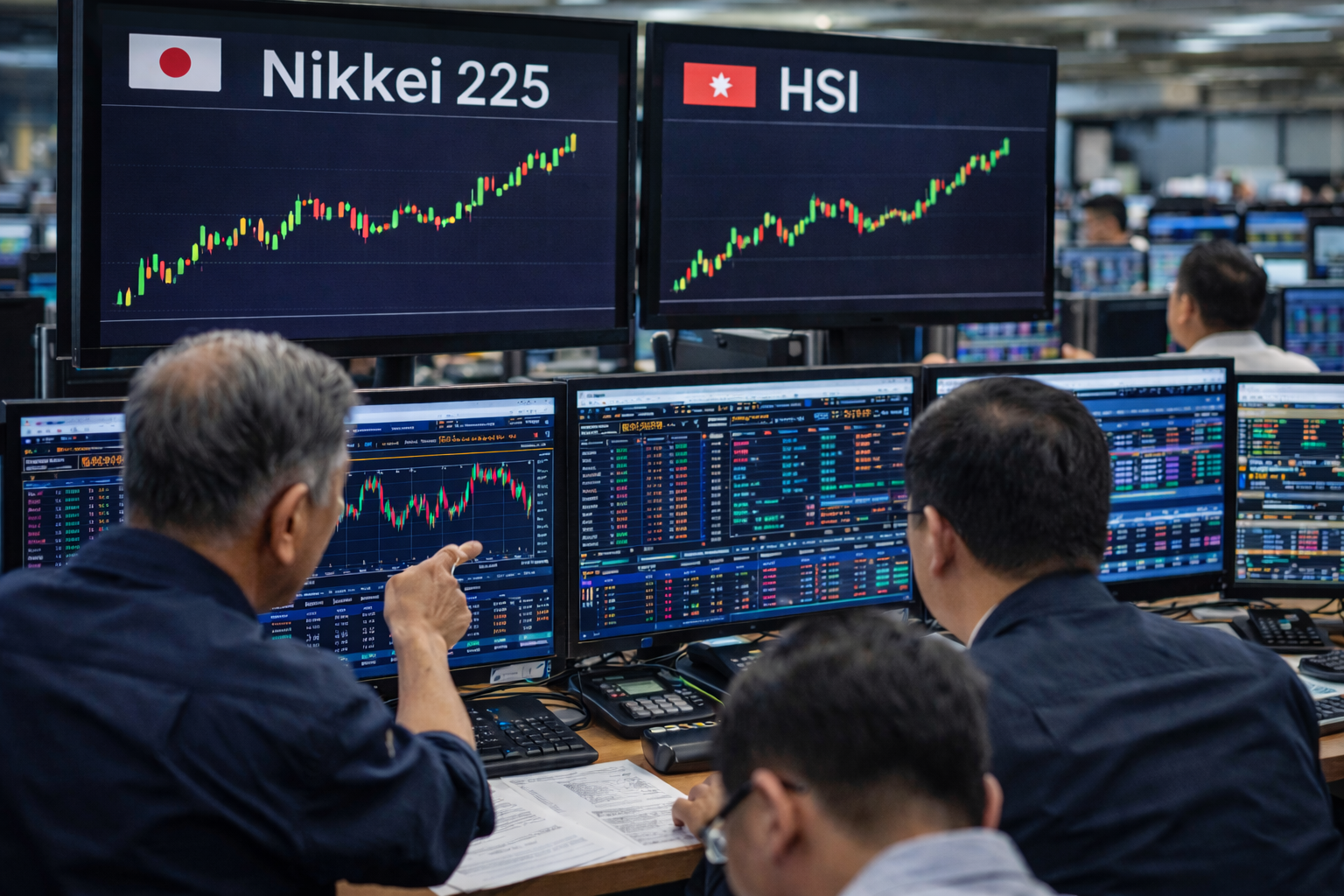
South Korean and Japanese stocks fell on Tuesday despite an overnight rebound in US technology shares, as investors remained unwilling to rebuild exposure to Asia’s biggest artificial intelligence trades before a crucial earnings week.
The KOSPI was down 2.36% at 5,631.95 by 11:20 am in Seoul, after touching 5,493.24. Japan’s Nikkei 225 lost about 0.6% to 64,512 at its midday break.
That contrasted with Monday’s 1.11% Nasdaq gain and 1.61% advance in the Philadelphia Semiconductor Index. It was another sign that bargain hunting on Wall Street has not yet restored confidence in Asian technology valuations.
KOSPI falls as foreign investors return to selling Korean chips
The Korean decline was driven by renewed selling a day after Monday’s 1.76% KOSPI rebound.
By 10:30 am, overseas funds had sold 605.8 billion won of shares and institutions another 470.7 billion won. Retail buying of 832.1 billion won was insufficient to stop the slide.
SK Hynix lost 3.6% and Samsung Electronics dropped 1.5% at that snapshot, even after paring steeper early losses.
SK Hynix also faces questions over a possible US listing of its Solidigm memory subsidiary. Investors fear a separate valuation could divert capital or dilute the Korean-listed parent’s appeal, although a transaction has not been confirmed.
The warning extended beyond chips. Data-centre operator Elice opened below its IPO price, illustrating the tougher financing market for AI infrastructure.
Kiwoom Securities analyst Han Ji-young said a sustained KOSPI recovery would require the benchmark to reclaim its 200-day moving average near 6,410, a demanding hurdle after this month’s steep losses.
Nikkei remains vulnerable to SoftBank and AI funding doubts
Japan’s losses were less severe, but the pressure points were familiar.
SoftBank Group fell about 3.3% early in the session, while cable maker Fujikura lost 3.4% and memory producer Kioxia was also weaker.
The Nikkei has become particularly sensitive to the financing of AI capacity, not merely demand for chips.
SoftBank represents the investment side of that cycle, while Japanese equipment and component suppliers depend on customers maintaining ambitious spending plans.
Nomura analysts argued that markets may be underestimating AI profitability because infrastructure spending comes well before revenues mature.
Established cloud businesses remain profitable, they said, even as losses at smaller AI operators unsettle investors.
Oil, European risks and earnings keep Asia on edge
The MSCI Asia-Pacific index excluding Japan fell 0.93%, while Hong Kong’s Hang Seng lost about 1% and Australia’s ASX 200 declined 0.8%. Mainland China’s Shanghai Composite was roughly unchanged.
Brent traded close to $110 a barrel, sustaining inflation and borrowing-cost concerns despite Washington’s move to ease some Russian energy restrictions.
Political unrest in France also weighed on European sentiment. Euro Stoxx 50 futures fell 0.71%, DAX futures slipped 0.4% and FTSE futures lost 0.44%, while US S&P 500 futures were broadly flat.
The post Here’s why KOSPI and Nikkei 225 are falling sharply on October 20 appeared first on Invezz
