
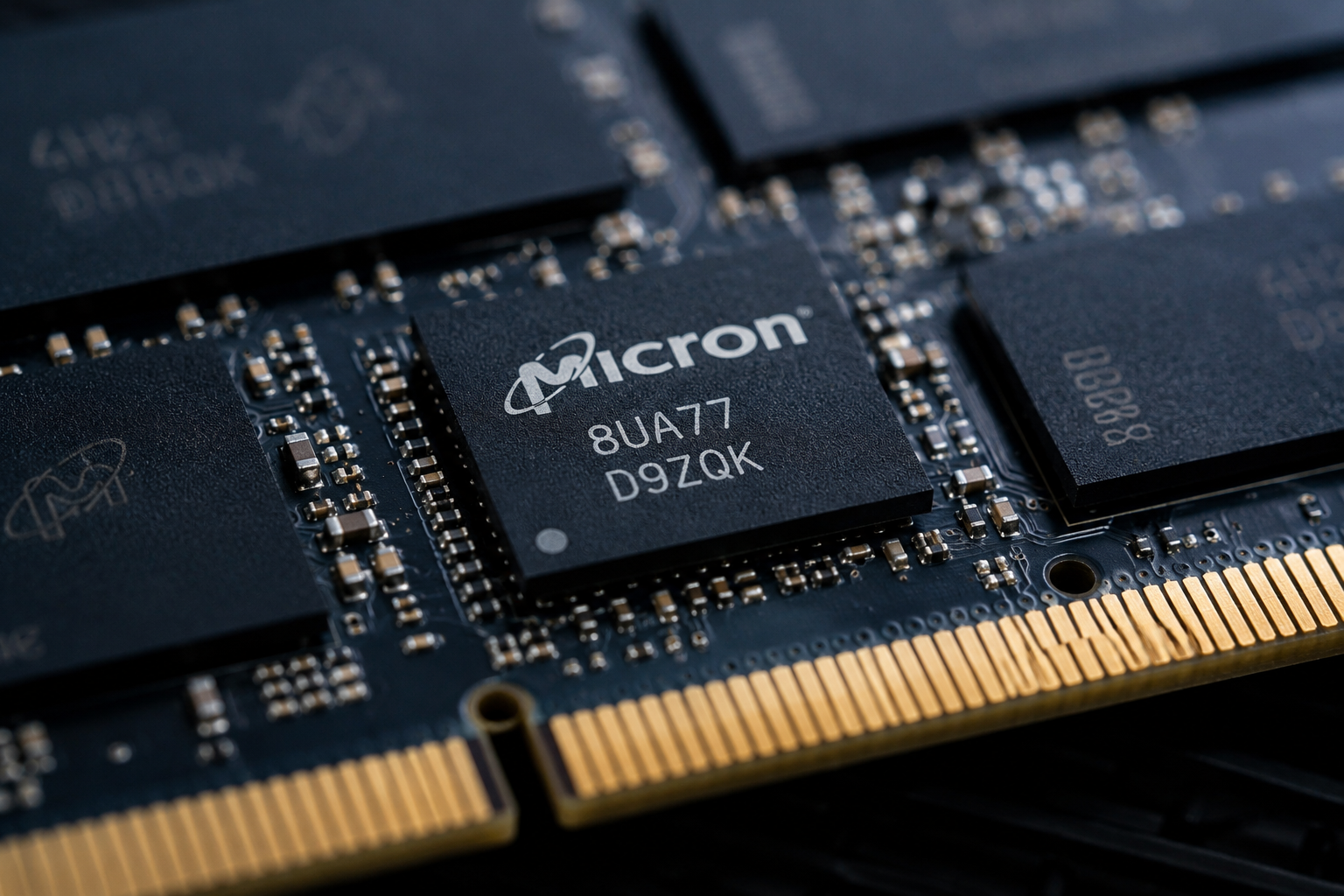
Micron faces a fresh challenge to its recovery after workers at a Taiwanese facility announced plans to strike on Thursday over a dispute about profit-sharing.
The Taoyuan walkout, scheduled for 22 October, comes as the US memory-chip producer seeks to recover from a 14.6% share-price slump last week. Micron rebounded 2.97% on Monday to close at $904.90.
The dispute threatens to complicate production at a time when demand for artificial intelligence memory remains strong.
But the immediate question for investors is whether the action stays limited to Taoyuan or spreads to Micron’s larger manufacturing operation in Taichung.
Micron stock: How serious is the Taiwan strike threat?
The Taoyuan union said its planned strike would coincide with mediation involving workers at Micron’s Taichung facility.
Previous discussions at Taoyuan ended without agreement. Micron has offered significant bonuses, but employees are seeking a predictable formula instead.
Some 1,994 workers, representing 99% of ballots cast, voted earlier this month to authorise industrial action. The union wants a permanent arrangement allocating 15% of operating profit to employees rather than discretionary bonuses.
Taiwan is central to Micron’s DRAM production, including high-bandwidth memory used in AI servers. A lengthy disruption could interfere with deliveries during tight supply.
Still, the union has not specified how long Thursday’s action will last. Taichung’s union remains in negotiations and has not authorised a strike.
Daniel Sparks, an investment writer at The Motley Fool, said on Monday that a negotiated settlement remained more likely than a prolonged shutdown, although an extended strike at Micron’s larger Taichung facility could put significant pressure on its shares.
Why did Micron stock lose nearly 15%?
The labour dispute arrives after a broader retreat from semiconductor shares.
Micron fell from $1,029 on 9 October to $878.84 on 16 October. Reports of advances in DRAM design by Chinese producer CXMT prompted questions about future competition, while rising financing costs raised doubts about the pace of AI data-centre construction.
Neither development proves that Micron’s current orders are weakening. But chip stocks are sensitive to expectations about future demand and prices, particularly following a period of unusually strong profits.
Dario Perkins, managing director of global macro at TS Lombard, warned that semiconductor businesses are “notoriously cyclical” and can swing sharply between shortages and oversupply.
He also highlighted the danger of customers ordering extra chips during shortages, potentially leaving manufacturers exposed to surplus inventories if spending slows.
Can committed orders protect the stock?
Micron’s underlying sales outlook offers an important counterweight to the risks.
Management said in September that more than 75% of fiscal 2027 shipments were already committed. Its new Taichung assembly and testing facility also has capacity booked for 2027.
That visibility supports revenues, but it also makes reliable deliveries more important. Missed production schedules could create problems with customers even if prices stay firm. Customers might shift orders to rival memory producers if delivery promises are broken.
Brian Mulberry, chief market strategist at Zacks Investment Management, told Reuters on Monday that “there is still value in the AI momentum” after the previous week’s selling drove some nervous traders out.
The post Micron stock faces fresh trouble after a 15% crash: is another selloff coming? appeared first on Invezz
